Jean-Michel Basquiat: Fame, Death, Net Worth & Personal Life
Ask someone to name a 1980s artist who changed everything, and Jean-Michel Basquiat’s name comes up fast. His crown-of-thorns skull paintings and cryptic SAMO tags are instantly recognizable, yet many details about his short life remain tangled in myth.
Full name: Jean-Michel Basquiat ·
Born: December 22, 1960 ·
Died: August 12, 1988 (aged 27) ·
Known for: Neo-expressionist painting, SAMO graffiti ·
Record auction price: $110.5 million (Untitled, 1982) ·
Estimated estate value at death: $100 million
Quick snapshot
- Died of a heroin overdose at age 27 (Whitney Museum of American Art)
- Dated Madonna briefly in 1982–1983 (Brooklyn Museum)
- No documented children (Whitney Museum of American Art)
- Estate inherited by his father, then sisters (Wikipedia)
- Whether Basquiat had a disability (no confirmed diagnosis) (Morning Times)
- Exact net worth at death (estimates range $45M–$200M) (Wikipédia (fr))
- Details of his relationship with his father (Morning Times)
- 1960: Born in Brooklyn (Whitney Museum)
- 1977: Began SAMO graffiti (Brooklyn Museum)
- 1982: Met Warhol, dated Madonna (Brooklyn Museum)
- 1988: Died at age 27 (Whitney Museum)
- 2017: Painting sold for $110.5M (Sotheby’s)
- Estate managed by sisters continues licensing and sales
- Art market demand remains strong, with new exhibitions
- Further research may clarify contested personal details
Ten key facts, one pattern: the official record is remarkably solid for the major milestones, but the numbers around money and personal health are fuzzier than most biographies admit.
| Label | Value |
|---|---|
| Full name | Jean-Michel Basquiat |
| Born | December 22, 1960, Brooklyn, NY |
| Died | August 12, 1988, Manhattan, NY |
| Cause of death | Heroin overdose (accidental) |
| Occupation | Painter, graffiti artist |
| Known for | Neo-expressionism, SAMO tag, Warhol collaboration |
| Net worth at death | Estimated $100 million estate |
| Record auction price | $110.5 million (Untitled, 1982) |
| Children | None |
| Disability | No confirmed disability |
Why is Basquiat so famous?
Basquiat became a household name in just seven years of painting, yet his fame posthumously outstripped anything he experienced alive. That disconnect is the real story.
What is Basquiat best known for?
- Neo-expressionist paintings that combine text, symbols, and African motifs (Whitney Museum of American Art)
- His SAMO graffiti tag that appeared all over downtown New York in the late 1970s (Brooklyn Museum)
How did Basquiat start his career?
Basquiat began as a teenage graffiti poet and musician before transitioning to painting in SoHo galleries by 1981 (Brooklyn Museum). His early exposure to art came at age six when his mother enrolled him as a Junior Member at the Brooklyn Museum.
What role did SAMO play in his fame?
The SAMO tag—short for “Same Old Shit”—appeared on walls and subway cars across downtown New York, gaining Basquiat a cult following before he ever picked up a paintbrush. The graffiti duo with Al Diaz ran from 1977 to 1979 (Brooklyn Museum).
Why is his work still celebrated?
Basquiat’s art focused on dichotomies such as wealth versus poverty, integration versus segregation, and inner versus outer experience (Wikipedia). The raw energy and social commentary keep his paintings highly relevant, and record auction prices—$110.5 million for a 1982 skull painting—ensure constant attention.
“Jean-Michel Basquiat was just 27 when he died, in 1988, a strikingly gorgeous young man whose stunning, genre-wrecking work had already brought…” — The Guardian, 2017
Why did Basquiat pass away?
Basquiat died of a heroin overdose on August 12, 1988, in his Manhattan loft. The medical examiner ruled it accidental.
What was the official cause of death?
The Whitney Museum states clearly that Basquiat died of a heroin overdose (Whitney Museum of American Art). The Brooklyn Museum similarly notes he “began using heroin and died of a drug overdose when he was 27” (Brooklyn Museum).
Where did Basquiat die?
He was found in his Great Jones Street loft by his girlfriend. The location is now part of the mythology surrounding his short life.
Was his death sudden?
While Basquiat had struggled with heroin addiction, his death at 27 shocked the art world. He had been painting and exhibiting up until the final weeks.
The pattern: Basquiat’s death is one of the most well-documented facts of his life, yet the exact circumstances remain the subject of many speculative accounts.
How rich was Basquiat when he died?
Numbers reported for Basquiat’s net worth at death vary wildly—from $45 million to $200 million—because most totals combine his estate’s later market value with his personal holdings at the time.
What was Basquiat’s net worth at death?
The commonly cited figure is $100 million, but French Wikipedia notes the succession was estimated at 45 million dollars (Wikipédia (fr)). A 2013 DNAinfo report said his father left behind an estimated $45 million estate, largely composed of his son’s art (DNAinfo).
How much did his paintings sell for during his lifetime?
During his active years, Basquiat sold paintings for $10,000 to $50,000—far below the tens of millions they command today.
What is the value of his art today?
The record came in 2017 when Untitled (1982) sold for $110.5 million at Sotheby’s. Other works regularly fetch $10–$40 million at auction. Jay Z purchased a Basquiat painting for $4.5 million in 2013.
The implication: Basquiat’s wealth is a moving target because the art market has inflated his legacy far beyond his own earnings.
Did Basquiat date Madonna?
The relationship with Madonna is often exaggerated. They dated briefly in 1982–1983 and remained friends afterward.
How long did Basquiat and Madonna date?
The Brooklyn Museum confirms the relationship lasted about a year (Brooklyn Museum). Madonna later said in interviews, “He was a genius. I loved him very much.”
Did their relationship impact their careers?
Both were rising stars in 1980s New York. Madonna’s pop career was just taking off, while Basquiat was establishing himself in the art world. The timing made them a tabloid fixture for a brief period.
“He was a genius. I loved him very much.” — Madonna
Who inherited Basquiat’s money?
Basquiat died without a will, so New York intestacy law directed his assets to his parents—not a spouse or child.
How was Basquiat’s estate handled?
His father, Gérard Basquiat, became the administrator of the estate until his death in 2013 (Wikipedia). The estate then passed to Basquiat’s sisters, Lisane and Jeanine Basquiat.
Who manages the estate today?
Basquiat’s sisters now control the estate, overseeing licensing, exhibitions, and sales. They continue to release new merchandise and digital content.
Did any family members inherit his wealth?
No spouse or children existed, so the entire estate went to his father, and later to his sisters. His mother, Matilde, was not a direct beneficiary under the law, though she later received some proceeds through her own inheritance from her son’s estate.
The catch: because Basquiat left no will, the distribution of his wealth became a matter of state law rather than his own wishes.
Frequently asked questions
What does the crown in Basquiat’s paintings mean?
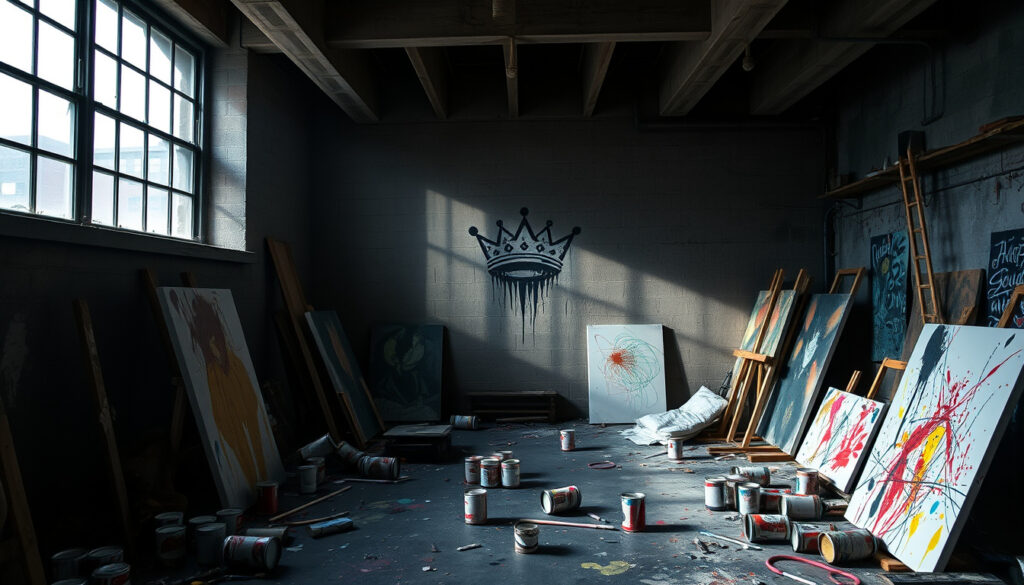
The three-pointed crown is a recurring symbol that Basquiat used to represent royalty, fame, and his own aspirations as a Black artist. It often appears in his portraits and self-portraits.
Was Basquiat married?
No, Basquiat was never married.
How many paintings did Basquiat create?
Estimates vary, but the Basquiat estate catalogues roughly 1,000 paintings and 2,000 drawings. He produced a huge volume in just seven years.
Who were Basquiat’s main influences?
He was influenced by jazz musicians (Charlie Parker, Miles Davis), graffiti art, African art, and artists such as Jean Dubuffet and Cy Twombly.
What is the highest price ever paid for a Basquiat painting?
$110.5 million for Untitled (1982) sold at Sotheby’s in 2017, making it one of the most expensive paintings by an American artist.
Did Basquiat have any siblings?
Yes, he had two younger sisters, Lisane and Jeanine.
Where is Basquiat buried?
Basquiat was cremated, and his ashes were returned to his family. No public burial site is known.
What was Basquiat’s relationship with Andy Warhol like?
Basquiat and Warhol were close friends and collaborators in the mid-1980s. They worked on a series of joint paintings and frequently appeared together in public. Warhol’s death in 1987 deeply affected Basquiat.
More related posts
 Bow Wow: Career, Net Worth, Family, and Latest Updates (2025)
 Square One Insurance Services: Reviews, Cancellation & Services
 Henrik Lundqvist: Career, Retirement, Hall of Fame & Life Today
 Marwah Rizqy: Expulsion, Biography and Controversy
 Zach Galifianakis: Sobriety, Ethnicity, and Island Home
 Vegas Matt: Real Name, Net Worth, and Current Location
 Mahima Chaudhry: Marriage, Accident, and Life After Bollywood
 Sea Salinity: Average, Highest, and How It’s Measured
