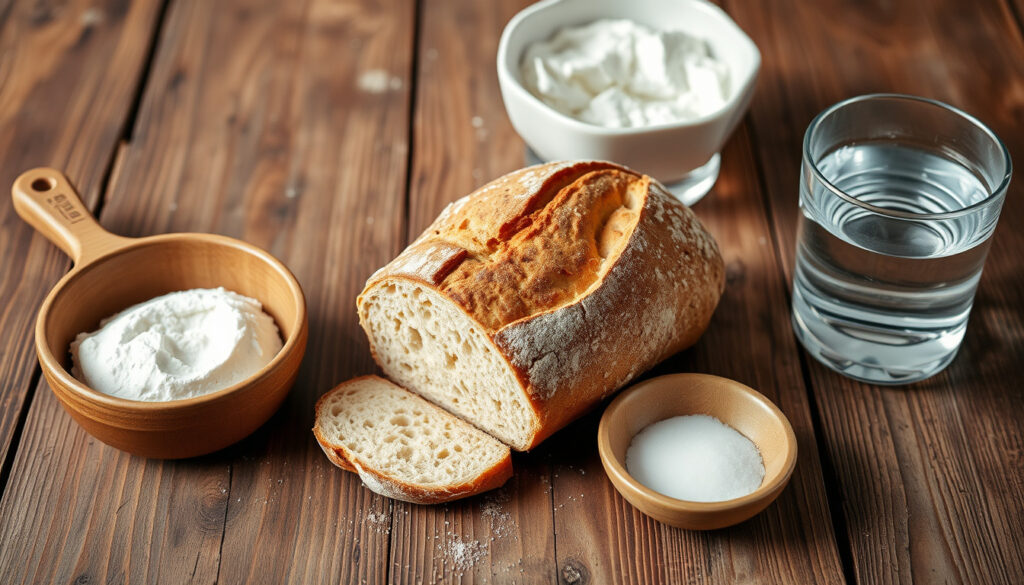
How to Make Bread: Simple Step-by-Step Guide (4 Ingredients)
There’s something almost magical about turning flour, water, salt, and yeast into a warm, crusty loaf. This guide walks you through the entire process from mixing to baking, with clear steps and troubleshooting tips so you can make reliable homemade bread without any special equipment.
Basic bread ratio: 100% flour, 60% water, 2% salt, 1% yeast by weight · Proofing time: 1-2 hours for first rise · Baking temperature: 400-450°F (200-230°C) · Baking time: 25-35 minutes for a loaf · Typical loaf yield: 1 loaf from 500g flour
Quick snapshot
- Bread flour with 12‑14% protein yields the best structure (Tastes Better From Scratch (popular cooking blog))
- Yeast dies above 130°F (54°C) (Sally’s Baking Addiction (trusted baking resource))
- Kneading develops gluten for elastic dough (Tastes Better From Scratch (popular cooking blog))
- Exact hydration level varies by flour brand and humidity
- Ideal proofing time depends on room temperature
- Preferred flour type is subjective based on final texture desired
- Yeast activation: 5‑10 minutes (Tastes Better From Scratch (popular cooking blog))
- First rise: 1‑1.5 hours until doubled (Tastes Better From Scratch (popular cooking blog))
- Second rise: 30‑60 minutes (Olga’s Flavor Factory (recipe developer))
- Baking: 25‑40 minutes depending on loaf size (Butter with a Side of Bread (home baking blog))
- Try adding herbs or cheese to the dough
- Experiment with whole wheat or rye flours
- Learn sourdough starter maintenance
The pattern: Each variable interacts with the others — warmer water speeds fermentation, higher protein flour absorbs more liquid, and salt controls yeast activity. Nail these ratios and the rest follows.
| Label | Value |
|---|---|
| Required ingredients | Flour, water, salt, yeast |
| Minimum water temperature | 105°F (40°C) for active dry yeast |
| Ideal flour protein content | 12-14% for bread flour |
| Kneading time | 8-10 minutes by hand |
| Proofing temperature range | 75-85°F (24-29°C) |
What are the 4 main ingredients in bread?
Homemade bread requires only four pantry staples. Understanding how each one works will help you adjust the recipe when things go wrong.
Flour
- Bread flour (12‑14% protein) forms the strongest gluten network (Tastes Better From Scratch (popular cooking blog)).
- All-purpose flour works but needs longer kneading (Sally’s Baking Addiction (trusted baking resource)).
- Whole wheat flour absorbs more water; add 2‑3 tablespoons extra per cup (Butter with a Side of Bread (home baking blog)).
Water
- Water hydrates the flour, activates yeast, and controls dough temperature.
- For active dry yeast, water should be 105–115°F (40–46°C) (Tastes Better From Scratch (popular cooking blog)).
- Cold water slows fermentation; hot water (above 130°F) kills yeast (Sally’s Baking Addiction (trusted baking resource)).
Salt
- Salt strengthens the dough structure and controls yeast activity (Olga’s Flavor Factory (recipe developer)).
- Too much salt slows or stops rising; use about 2% of flour weight.
Yeast
- Three common forms: active dry, instant, and fresh (Tastes Better From Scratch (popular cooking blog)).
- Active dry yeast must be proofed in warm water; instant yeast can be mixed directly with flour.
- Yeast feeds on sugar (or the natural sugars in flour) to produce carbon dioxide, which makes the dough rise.
If you understand the role of each ingredient, you can diagnose a failed loaf without guessing. Dense bread? Under‑proofed or too much salt. Flat bread? Old yeast or water too hot.
Four ingredients, infinite variations. Master the ratio (100:60:2:1) and you can adapt any recipe — swap flours, change hydration, or add inclusions — and still get a reliable rise.
How do I make homemade bread?
Follow these six steps for a classic loaf. Each step builds on the previous one — shortening the first rise leads to a dense crumb, while skipping the second rise gives a flat top.
Mix ingredients
- Combine flour, salt, and yeast in a large bowl.
- Add warm water (and a teaspoon of sugar if using active dry yeast) (Tastes Better From Scratch (popular cooking blog)).
- Stir until a shaggy dough forms.
Knead the dough
- Turn dough onto a lightly floured surface and knead for 8‑10 minutes (Tastes Better From Scratch (popular cooking blog)).
- The dough should become smooth and elastic (Olga’s Flavor Factory (recipe developer)).
First rise
- Place dough in a greased bowl, cover with a damp cloth, and let rise until doubled (1‑1.5 hours) (Tastes Better From Scratch (popular cooking blog)).
- Warm spot (75‑85°F / 24‑29°C) speeds fermentation.
Shape
- Punch down the dough to release air bubbles (Tastes Better From Scratch (popular cooking blog)).
- For a loaf pan: roll dough into a rectangle, then roll it up tightly. Place seam‑side down in the greased pan (Olga’s Flavor Factory (recipe developer)).
Second rise
- Cover and let rise again for 30‑60 minutes, or until doubled (Olga’s Flavor Factory (recipe developer)).
Bake
- Preheat oven to 400°F (200°C) for a standard loaf.
- Bake for 25‑35 minutes (Butter with a Side of Bread (home baking blog)).
- Internal temperature should reach 195‑200°F (90‑93°C) (Sally’s Baking Addiction (trusted baking resource)).
- Cool completely on a wire rack before slicing.
The pattern: Skipping or shortening the first rise leads to a dense crumb; skipping the second rise gives a flat top. Follow the timing and you’ll get an open, airy texture every time.
The biggest beginner mistake: under‑kneading. If the dough tears easily when you stretch it, keep kneading for another 2‑3 minutes. Elastic dough that holds a thin membrane when stretched is ready (Tastes Better From Scratch (popular cooking blog)).
What’s the easiest bread to make from scratch?
Three beginner‑friendly recipes require almost no special equipment and deliver great results on the first try.
No knead artisan bread
- Uses only 4 ingredients — flour, water, salt, yeast — no kneading required (Sally’s Baking Addiction (trusted baking resource)).
- Dough rests overnight or for 12‑18 hours, then is shaped and baked at 475°F for 20‑25 minutes.
- Produces a crusty, bakery‑style loaf with minimal effort.
Simple white loaf
- Standard pan loaf with a soft crumb; requires kneading and two rises.
- Total time about 3 hours from start to finish (Tastes Better From Scratch (popular cooking blog)).
- Easiest to slice for sandwiches.
Quick bread soda bread
- Uses baking soda instead of yeast, so no rising time (Butter with a Side of Bread (home baking blog)).
- Requires an acid (buttermilk, vinegar, or lemon juice) to activate the soda.
- Ready in under an hour.
Start with the no‑knead artisan recipe — it removes the two most intimidating steps (kneading and timing) while still producing a loaf that looks and tastes professional.
What type of flour is best for bread?
Flour choice directly affects texture, rise, and flavor. Here’s how the common types compare.
Bread flour vs all-purpose flour
- Bread flour (12‑14% protein) gives the highest rise and chewiest crumb (Tastes Better From Scratch (popular cooking blog)).
- All‑purpose flour (10‑12% protein) works fine for most home bakers but may produce a slightly denser loaf (Butter with a Side of Bread (home baking blog)).
- If using all‑purpose, extend kneading by 2‑3 minutes to develop gluten.
Whole wheat flour
- Contains the entire wheat kernel, adding fiber and nutrients.
- Absorbs more water — increase liquid by 2‑3 tablespoons per cup of whole wheat flour (Sally’s Baking Addiction (trusted baking resource)).
- Produces a denser loaf; often blended with bread flour for better structure.
Rye flour
- Low in gluten (rye proteins don’t form the same elastic network) (Olga’s Flavor Factory (recipe developer)).
- Creates a dense, moist crumb with a distinctive tangy flavor.
- Best used in combination with bread flour (e.g., 50‑50 blend).
The catch: Higher protein flours give better structure but require more water and longer kneading. For your first few loaves, start with bread flour — it’s the most forgiving.
How do I make bread without yeast?
No yeast on hand? Three methods use alternative leaveners that work just as well.
Soda bread recipe
- Baking soda reacts with an acid (buttermilk, yogurt, or vinegar) to produce carbon dioxide (Butter with a Side of Bread (home baking blog)).
- No kneading or rising time — mix, shape, and bake immediately.
- Common variations include adding raisins or caraway seeds.
Beer bread recipe
- Beer provides carbonation and residual yeast from the brewing process.
- Simply mix self‑rising flour (or all‑purpose + baking powder) with beer, pour into a pan, and bake.
- Ready in about 45 minutes.
Sourdough starter alternative
- Sourdough uses wild yeast captured from the environment in a flour‑water starter (Sally’s Baking Addiction (trusted baking resource)).
- Requires 5‑7 days to establish a mature starter, then can be maintained indefinitely.
- Produces a tangy flavor and chewy crumb unique to natural fermentation.
If your pantry lacks yeast, you’re not out of luck — soda bread or beer bread can be on the table in under an hour. For a long‑term solution, a sourdough starter costs nothing and lasts forever.
What we know for sure and what’s still uncertain
Confirmed facts
- Bread flour with 12‑14% protein yields best structure (Tastes Better From Scratch (popular cooking blog))
- Yeast dies at temperatures above 130°F (54°C) (Sally’s Baking Addiction (trusted baking resource))
- Salt inhibits yeast activity; too much slows rising (Olga’s Flavor Factory (recipe developer))
- Kneading develops gluten for elastic dough (Tastes Better From Scratch (popular cooking blog))
What’s unclear
- Exact hydration level varies by flour brand and humidity
- Ideal proofing time depends on room temperature
- Preferred flour type is subjective based on final texture desired
What bakers and experts say
“Combine the flour, salt and yeast in a large bowl and make a well in the centre. Add the water and oil and mix to form a soft, slightly sticky dough.”
— BBC Good Food, step‑by‑step white bread recipe
“This artisan bread recipe is the best bread you can make — and it’s surprisingly easy! Only 4 ingredients, no kneading, and it tastes better than store‑bought.”
— Sally’s Baking Addiction, artisan bread note
Two respected sources confirm that simple, minimal‑ingredient breads are within reach of any home baker. The BBC Good Food method gives a structured pan loaf; Sally’s approach frees you from kneading. Both deliver excellent results.
Summary
Making bread from scratch with four ingredients is both simpler and more forgiving than many assume. The core ratio — 100 parts flour, 60 parts water, 2 parts salt, 1 part yeast — gives you a framework that works with any flour or rise schedule. For the beginner in a home kitchen, the choice is clear: start with a no‑knead artisan loaf and build confidence, or dive straight into a kneaded pan loaf and master the full process. Either way, the reward is a warm, crusty loaf that no store‑bought bread can match.
olgasflavorfactory.com, instructables.com, aducksoven.com, youtube.com, youtube.com
For a more detailed walkthrough, you can also check out this step-by-step bread guide from another trusted source.
Frequently asked questions
Why is my bread dense and heavy?
Likely causes: under‑kneading (dough didn’t develop enough gluten), over‑proofing (yeast exhausted before baking), or too much flour (dough too dry). Use a kitchen scale to measure ingredients by weight for consistency.
How long should I knead the dough?
Knead by hand for 8‑10 minutes until the dough is smooth and elastic. It should pass the “windowpane test” — stretch a small piece thin enough to see light through without tearing (Tastes Better From Scratch (popular cooking blog)).
Can I use all-purpose flour instead of bread flour?
Yes. All‑purpose flour (10‑12% protein) works but produces a slightly denser crumb. Extend kneading by 2‑3 minutes and consider adding 1 tablespoon of vital wheat gluten per cup to improve structure (Butter with a Side of Bread (home baking blog)).
How do I store homemade bread?
Store at room temperature in a paper bag or bread box for up to 3 days. Do not refrigerate — it accelerates staling. For longer storage, wrap tightly in plastic and freeze for up to 3 months.
Why did my bread not rise?
Possible reasons: yeast was expired or killed by water above 130°F (54°C), the room was too cold, or too much salt slowed fermentation. Always proof active dry yeast in warm water with a pinch of sugar to confirm it’s alive before adding flour.
Can I add herbs or cheese to the dough?
Absolutely. Add dried herbs (rosemary, thyme) or grated cheese (cheddar, parmesan) during the mixing stage. For cheese, reduce the salt slightly since cheese adds saltiness. Fold in ½ cup of inclusions per 500g flour.
How do I know when the bread is fully baked?
Check internal temperature with an instant‑read thermometer — it should reach 190‑200°F (88‑93°C) for a standard loaf (Sally’s Baking Addiction (trusted baking resource)). The loaf should sound hollow when tapped on the bottom.
Can I freeze homemade bread?
Yes. Cool completely, wrap tightly in plastic wrap then aluminum foil, and freeze. Thaw at room temperature. For best texture, reheat in a 350°F oven for 10 minutes.
Related reading: No-Bake Cheesecake Recipe · Oven Baked Chicken Drumsticks
More related posts
 Arnold Schwarzenegger: Heart Health, Diet & Sleep Habits
 Denise Filiatrault: Biography, Career, Awards, and Net Worth
 Oakville Homes for Sale 2026: Prices, Areas & Cost of Living
 Benfica vs Chelsea FC Lineups – Confirmed XIs, Injuries & Tactics
 Cast of 9-1-1: Main Actors, Salaries, and Real-Life Partners
 Sea Salinity: Average, Highest, and How It’s Measured
 Galen Weston: Biography, Net Worth, and the Weston Family Empire
 Janelle James: Abbott Elementary Star’s Biography & Life
