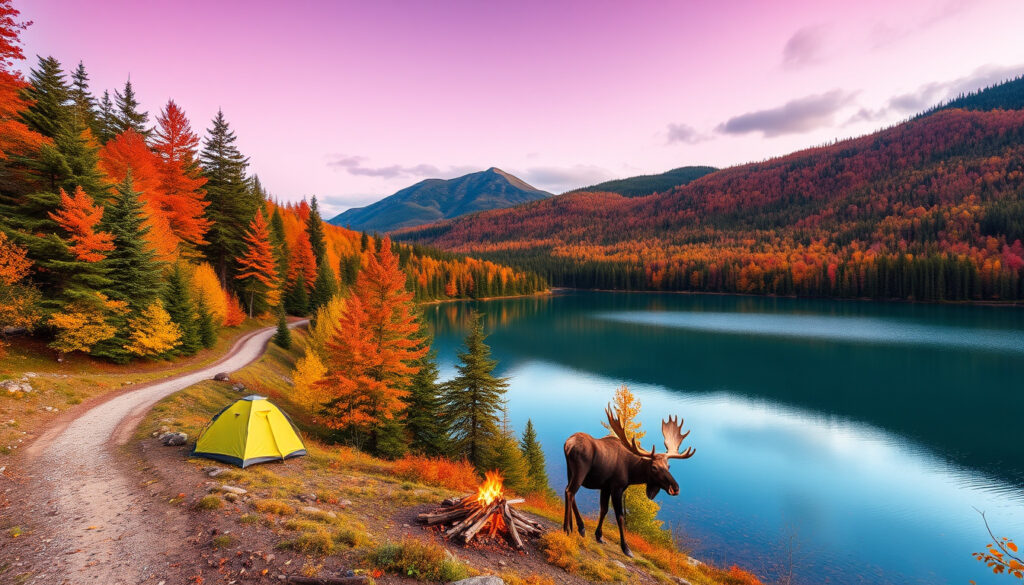
Mont-Tremblant National Park: Trails, Wildlife, Camping Guide
Quebec’s oldest provincial park packs 1,510 km² of old-growth forest and 400 lakes into a landscape just 30 minutes from Mont-Tremblant’s resort village—proof that genuine wilderness doesn’t require a long drive. The park’s six rivers and resident black bears draw hikers, campers, and paddlers seeking real backcountry, though the dense forest demands a few precautions before you set out.
Area: 1,510 km² · Lakes: 400+ · Rivers: 6 · Status: Quebec’s oldest provincial park · Location: 30 minutes from Mont-Tremblant resort
Quick snapshot
- Quebec’s oldest provincial park and fourth largest (Wikipedia)
- Home to 40+ mammal species including black bears and wolves (Carefree Creative)
- 11 summer hiking trails and 82 km of winter trails (Carefree Creative)
- Exact bear encounter frequency in peak season
- Complete trail difficulty ratings for all 11 routes
- Current 2026 camping permit fees and reservation windows
- Dark-sky preserve designation in 2023 (Wikipedia)
- Green Mountain National Forest mandated bear-safe storage in 2019 — similar rules may spread to other Canadian parks (Green Mountain Club)
These park statistics establish Mont-Tremblant’s scale compared to other Quebec wilderness areas.
| Fact | Detail |
|---|---|
| Established | Quebec’s oldest provincial park |
| Size | 1,510 km² |
| Lakes | 400+ |
| Rivers | 6 |
| Location | Near Mont-Tremblant resort |
| Managing authority | SÉPAQ (Société des établissements de plein air du Québec) |
| Open | 365 days a year |
| Dark-sky preserve | 2023 |
“Bears are extremely sensitive to the stress of human activity, generally preferring to avoid people.”
— Parks Canada, Government Authority
“The black bear is shy and generally avoids humans.”
— Tremblant Blogue, Local Tourism
What is special about Mont-Tremblant National Park?
Mont-Tremblant sits in Quebec’s Laurentian mountains as the province’s oldest and fourth-largest protected wilderness area — a distinction it has held for decades under SÉPAQ management (Wikipedia). The park spreads across 1,510 km² of forested hills, hollows, and sandy shores that drop directly into lakes, a rarity in parks where shorelines tend to be rocky or marshy. That 400-plus lakes and six named rivers give the landscape a water density that paddlers and anglers find hard to match anywhere in eastern Canada.
Forested hills and unique sandy shores
Unlike the granite barrens of some Canadian parks, Mont-Tremblant’s valleys hold deep glacial soil that supports dense mixed forest. The sandy beaches along Lac Monroe and Lac Supérieur catch visitors off guard — most expect boreal rocks, not a beach you could mistake for a lakeside town further south.
Oldest provincial park in Quebec
Quebec created its first provincial parks system in the early twentieth century, and Mont-Tremblant was among the inaugural designations. That head start gave the forest time to mature into the old-growth character that wildlife biologists associate with species like the eastern wolf (Tremblant Blogue).
Vast network of lakes and rivers
With over 400 lakes threaded by six rivers, the park offers 11 summer hiking trails and 82 km of dedicated winter routes for cross-country skiing and snowshoeing (Carefree Creative). The water network is not just scenery — it structures the park’s zoning, with interior lakes accessible only by paddling, keeping the deepest backcountry quiet enough for wildlife.
What animals are in Mont-Tremblant National Park?
Mont-Tremblant hosts over 40 mammal species — a list that runs from tiny chipmunks at your campsite to eastern wolves working the interior valleys (Carefree Creative). Black bears draw the most visitor curiosity and the most anxiety, so worth addressing both.
Common wildlife sightings
Moose, white-tailed deer, red foxes, beavers, otters, porcupines, raccoons, and chipmunks round out the more frequently seen residents. Eastern wolves play a genuine ecological role here, maintaining deer and moose populations in check — visitors rarely see them but often find tracks near rivers in early morning (Tremblant Blogue). The park’s designation as a dark-sky preserve in 2023 means light pollution stays low enough that nocturnal animals like the flying squirrel remain largely undisturbed (Wikipedia).
Presence of bears and precautions
Black bears inhabit the park, with sightings concentrated around the La Macaza area and near the village fringe where forest meets infrastructure (Tremblant Blogue). The critical fact for every visitor: black bears in Quebec are shy and generally avoid humans — encounters with aggressive behavior are low risk with proper planning (Parks Canada). The park’s interior lakes, reachable only by paddling, tend to see fewer bear sightings simply because foot traffic is lighter.
What this means: your chances of a close bear encounter are lower here than in mountain parks further west, but the standard precautions still apply — store food properly, hike in groups, and know what to do if you do cross paths with one.
Are there bears near Mont-Tremblant?
Yes — black bears live throughout the park’s forested interior, though they actively avoid people whenever possible (Tremblant Blogue). Sightings cluster around three zones: the La Macaza sector, the Haute-Rouge area, and the boundary areas where park forest meets village or resort infrastructure. Most visitors never see a bear, but knowing they are present shapes how you handle food, campsites, and trail choices.
Bear habitats and sightings
Bears prefer dense forest with berry patches, fallen logs for insects, and proximity to water — conditions that describe most of Mont-Tremblant’s interior. The Haute-Rouge and La Macaza sectors offer the highest sighting reports, partly because hiking traffic concentrates there (Tremblant Blogue). Bears are more active at dawn and dusk, which is also when most hikers are either finishing or starting their day on longer trails (Parks Canada).
Safety tips for visitors
Parks Canada lays out the protocol: do not run from a bear — speak calmly, back away slowly, and avoid direct eye contact (SABRE). If a bear approaches, make yourself appear large, pick up children, and hold your ground. Bears can run as fast as a racehorse uphill and downhill, and both black and grizzly bears can climb trees, so tree-climbing is not a reliable escape (U.S. National Park Service).
Aggressive bear encounters in Mont-Tremblant are rare, but the consequences are severe enough that carrying bear spray on interior hikes is standard practice among experienced backcountry visitors. A canister costs under $50 and weighs nothing — Parks Canada recommends it for any hike more than 30 minutes from a vehicle (Parks Canada).
For defensive attacks — when a bear charges and then contacts you — playing dead with your hands clasped over your neck protects vital areas. For predatory attacks, which Parks Canada notes are extremely rare with black bears, fighting back aggressively is the correct response. Camp at least 70m from water sources and store all food 50m downwind from your tent (Parks Canada).
What is the best month to go to Mont-Tremblant?
Late spring through early autumn covers the warmest months with full trail access, while winter transforms the park into a cross-country skiing and snowshoeing destination. The “best” month depends entirely on what you want to do.
Weather patterns by season
July and August deliver the warmest temperatures and longest days, with lakes warm enough for swimming — unusual for Quebec, where most inland water stays cold year-round. September brings cooler air, fewer crowds, and the start of fall foliage. By October, many interior trails close as wet weather makes them slippery, though the park itself stays open year-round (Official Mont Tremblant). Winter from December through March locks the lakes and turns 82 km of summer hiking routes into groomed cross-country ski trails (Carefree Creative).
Peak times for activities
July draws the largest crowds, particularly around the sandy beaches at Lac Monroe. Families with young children tend to favor July-August for warm-weather camping at La Pimbina campground. Hard-core hikers favor late September for fall color without the August insects. Snowshoe enthusiasts peak in January-February when snowpack is most reliable. Explore more Canadian trails and winter activities for regional context.
The trade-off: July means more people on popular trails like the Grand Brûlé to Pic White loop, a challenging 11.6 km round-trip route with scenic overlooks of Lac Monroe (Carefree Creative). September gives you the same trail nearly to yourself but with shorter daylight hours.
What are things to do in Mont-Tremblant National Park?
Mont-Tremblant stays active all four seasons — summer brings paddling, hiking, and camping, while winter shifts to skiing, snowshoeing, and snowmobiling on designated trails. The park draws adventure tourists who want more than resort views.
Hiking trails and maps
Eleven summer trails range from short lakeside walks to full-day ridge hikes, with difficulty ratings and clear waymarking throughout (Carefree Creative). The Grand Brûlé to Pic White trail at 11.6 km round-trip is the park’s signature challenge — rewarded with sweeping views over Lac Monroe and the Laurentian ridgeline. Trail maps are available through SÉPAQ’s official site and at the park entrance, with free paper copies on-site (SÉPAQ). For something more adrenaline-forward, the Via ferrata du Diable offers an intermediate climbing-hiking hybrid bolted into the rock face, requiring no prior experience but a head for heights (SÉPAQ).
Camping and tickets
La Pimbina is the main frontcountry campground, with tent sites, washrooms, hot showers, and a laundromat — a practical setup for families not ready to go full backcountry (Carefree Creative). Backcountry camping requires permits and is accessible by hiking or paddling to interior sites (Carefree Creative). All visitors to Mont-Tremblant National Park require a daily entrance fee or seasonal pass, available through SÉPAQ’s online reservation system. Quality fleece jackets for Canadian outdoors make good packing choices for variable park weather.
Summer and winter activities
Summer: hiking, backcountry camping, kayaking, canoeing, fishing, and swimming. The via ferrata and mountain biking on designated trails add variety for active visitors. Winter: cross-country skiing and snowshoeing share 82 km of groomed and track-set trails, while a separate snowmobile network connects to regional routes (Official Mont Tremblant). Ice fishing and showshoe hikes round out the cold-season calendar.
The park’s year-round operation under SÉPAQ means it never closes — even during shoulder seasons when other regional parks shutter their gates, Mont-Tremblant remains accessible. For visitors building a trip around the resort and want a day of genuine wilderness, this matters. A 30-minute drive from the village puts you in a landscape that feels genuinely remote despite the proximity.
The implication: Mont-Tremblant works as a two-day addition to a resort trip or a standalone backcountry week. The infrastructure — paved roads to trailheads, clear maps, organized campgrounds — makes it approachable for families, while the backcountry zones satisfy experienced wilderness travelers who want to go deeper.
Mont-Tremblant shares its appeal with other Canadian parks such as Sleeping Giant Provincial Park, known for its hiking trails and camping opportunities amid rugged terrain.
Frequently asked questions
What is the prettiest national park in Canada?
Beauty is subjective, but Mont-Tremblant stands out for its density of lakes and sandy shorelines — a feature uncommon in Canadian parks that typically favor rocky or marshy edges. Parks further west like Banff and Jasper offer mountain drama that Mont-Tremblant cannot match, but for eastern accessibility and water richness, Mont-Tremblant ranks among the most visually distinctive.
What celebrities are at Mont-Tremblant?
The resort draws Quebec celebrities and NHL players during ski season, but the national park itself is a wilderness zone — no VIP lounges, no velvet ropes. Visitors seeking a celebrity-sighting fix should try the resort village; those who want to see a black bear in the wild are in the right place.
What is the most visited national park in Canada?
Banff National Park in Alberta consistently tops visitation counts, drawing millions annually for its mountain scenery and iconic Lake Louise. Mont-Tremblant sees far fewer visitors despite being one of Quebec’s mostvisited provincial parks — partly because it lacks the international name recognition and partly because the province’s park system is smaller than Alberta’s.
Where can I find a Mont-Tremblant National Park map PDF?
SÉPAQ’s official site provides downloadable trail maps and park guides — search for “Mont-Tremblant National Park” at sepaq.com. Free paper maps are also available at the park entrance station. Trail-specific maps showing the Grand Brûlé to Pic White route and the Via ferrata du Diable are included in the main park brochure.
How to get Mont-Tremblant National Park photos?
Golden hour along Lac Monroe’s sandy beach and the ridgeline viewpoints on the Grand Brûlé trail produce the park’s most striking images. The 2023 dark-sky preserve designation means night photography from interior lakes reveals Milky Way clarity that urban and suburban locations cannot match. A wide-angle lens and a tripod are the two essentials.
What are Mont-Tremblant National Park trails like?
Eleven summer trails cover a wide range: flat lakeside loops suitable for families with strollers, rolling ridge walks of 3-5 km, and the full-day Grand Brûlé to Pic White challenge at 11.6 km round-trip. All trails are clearly marked with yellow blazes and wooden signs at junctions. Winter, 82 km of those same corridors become cross-country ski and snowshoe routes maintained by SÉPAQ.
What is the most unpopular national park?
This varies by metric — some Canadian parks in northern or remote regions see extremely low visitation simply due to access difficulty rather than any lack of appeal. Mont-Tremblant is the opposite: its proximity to a major resort and year-round access make it one of Quebec’s busier parks, which some wilderness purists consider a drawback.
More related posts
 Richard Pryor: Biography, Cause of Death & Legacy
 Conan O’Brien: Biography, Net Worth, Wife & Oscars 2026
 Alicia Keys: Biography, Children, Genre & No Makeup Reason
 Patty Duke: Death, Net Worth, Children, Inheritance
 Colts vs Kansas City Chiefs Match Player Stats: 2025 OT Win
 Mark Normand: Comedy, Wife, Specials & Booking Info
 Katherine LaNasa: Cancer, Emmy Win & Late-Career Rise
 Rainn Wilson: Biography, Net Worth, and The Office
