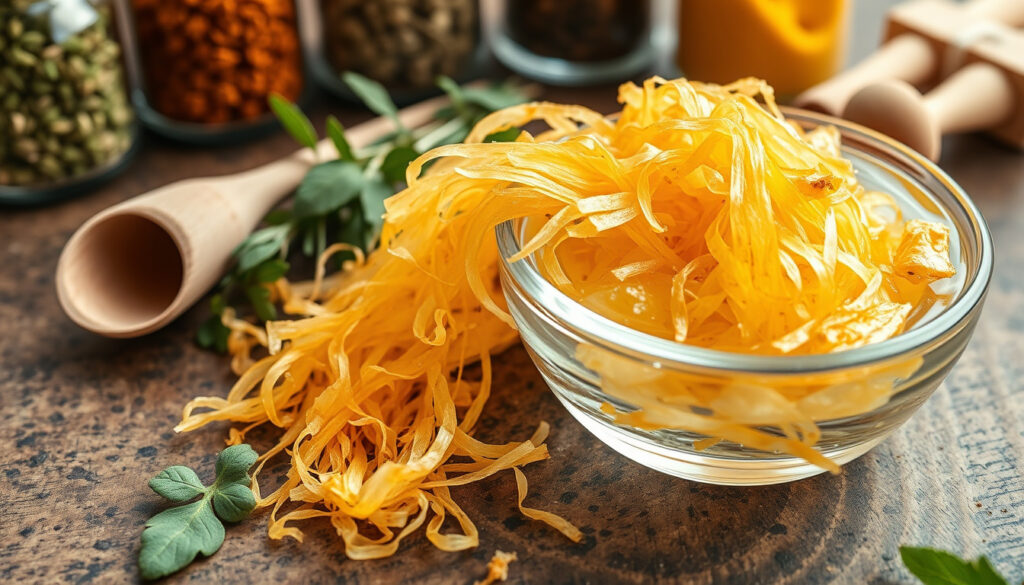
Gond Katira in English: Tragacanth Gum Benefits & Uses
If you’ve ever stirred a glass of shikanji on a scorching summer afternoon and noticed something gelatinous floating in it—that’s gond katira doing its job. The crystalline herb goes by a different name in English, and understanding what it actually is might change how you use it. Here’s what the science and traditional sources say about this natural gum, its real benefits, and what to watch out for.
English Name: Tragacanth Gum ·
Source Plant: Astragalus gummifer ·
Primary Property: Natural Coolant ·
Common Forms: Crystalline Sap ·
Key Use: Edible Thickener
Quick snapshot
- Tragacanth gum comes from Astragalus tree sap (Vedikroots)
- Forms a gel-like substance when soaked in water (Lybrate)
- Used as a natural cooling agent in summer beverages (Oncquest Labs)
- Serves as a natural laxative when soaked (PharmEasy)
- Acts as thickener and stabilizer in foods (ZanduCare)
- Provides electrolyte balance during physical activity (Oncquest Labs)
| Property | Value |
|---|---|
| English Equivalent | Tragacanth Gum |
| Botanical Source | Astragalus species |
| Texture | Odorless crystals |
| Preparation | Soak overnight |
| Caloric Profile | Low-calorie, low-carb |
| Food Application | Thickener, stabilizer, emulsifier |
What is the English name for Gond Katira?
Gond katira in English is called Tragacanth Gum—a natural gum derived from the dried sap of several species of Middle Eastern legumes in the Astragalus genus. The word “tragacanth” itself comes from the Greek words for “goat” and “thorn,” referring to the spiny shrubs that produce this substance.
Origin and plant source
The gum oozes from the Astragalus gummifer shrub through a natural process called gummosis, where the plant exudes sap in response to injury or drought. According to PharmEasy (pharmacy blog with health authority), this is the plant’s defense mechanism—the same way trees produce resin. The gum has been harvested for centuries across Iran, the Middle East, and South Asia, where it became a staple in Ayurvedic summer remedies.
Physical properties
Tragacanth gum appears as odorless, translucent crystals that swell into a gelatinous mass when soaked in water. Vedikroots (Ayurvedic supplier with product expertise) describes it as forming a mucilaginous gel—thick enough to coat the throat but smooth enough to drink. This gel-forming quality is what makes it useful in everything from traditional summer sherbets to modern food processing as a stabilizer and texture enhancer.
What are the benefits of Gond Katira?
The cooling claim deserves attention first, because it’s the most consistently reported across sources. Lybrate (health platform with practitioner-sourced information) states that gond katira possesses cooling properties that help prevent heat strokes by reducing body temperature. Multiple South Asian health sites, including Oncquest Labs, reinforce this use in traditional summer beverages for cooling, hydration, and digestive comfort.
Health benefits for skin and cooling
Often called “desi collagen” in Indian households, gond katira is applied topically to improve skin elasticity and soothe irritated skin. Oncquest Labs reports that its anti-inflammatory properties help reduce skin inflammation, while the high mucilage content keeps skin hydrated during dry, hot weather.
Digestive and respiratory support
Gond katira acts as a natural laxative for constipation relief—you soak it overnight, and it forms a jelly-like substance that promotes regular bowel movements. PharmEasy confirms this use, noting the high fiber content aids digestion. For respiratory issues, Instacare (health blog, tier3) reports it soothes cough and cold by coating the respiratory tract when soaked in honey and warm water.
Benefits for specific conditions
The evidence varies in strength. Stronger claims—cooling, constipation relief, hydration—appear across multiple tier-2 sources. Softer claims need qualification: ZanduCare (Ayurveda brand) reports gond katira boosts immunity and may slow cancer cell growth, but this claim has low confidence and lacks clinical validation. Similarly, claims about fatty liver support or belly fat reduction remain anecdotal.
Most documented benefits come from traditional use and health platforms—not peer-reviewed clinical trials. The cooling and digestive effects have enough cross-source agreement to be treated as plausible, but the cancer-fighting and immunity-boosting claims need more scrutiny before you treat them as fact.
What are the side effects of Gond Katira?
Gond katira is generally safe in moderation when properly soaked, according to PharmEasy. The key word is “moderation”—excess consumption can cause digestive upset, including bloating and gas, especially if you don’t soak it long enough before consuming.
Common risks
Because gond katira expands significantly when it absorbs water, consuming it without adequate soaking or drinking enough fluids alongside it may cause throat discomfort or intestinal blockage in rare cases. Instacare notes that people with pre-existing digestive conditions should approach with caution.
Allergic reactions
Since it’s derived from legumes, individuals with allergies to the Fabaceae family (which includes peas, beans, and lentils) may react to gond katira. Symptoms could range from mild skin irritation to more serious respiratory issues. PharmEasy advises a patch test before topical application and starting with a small dose if you’re consuming it for the first time.
People on blood-thinning medications should consult a doctor before regular use—some sources suggest gond katira may have anticoagulant properties that could compound drug effects.
Who should not use Gond Katira?
Not everyone should incorporate gond katira into their routine. Understanding the contraindications matters as much as knowing the benefits.
Contraindications
Pregnant and breastfeeding women should exercise caution. Lybrate (health platform) flags this, noting that while gond katira is reportedly beneficial for lactating mothers in some traditions, the evidence is medium-confidence at best and medical guidance should precede any use.
Precautions for groups
- People with bleeding disorders: gond katira may affect blood clotting
- Those on anticoagulant medications: potential interaction risk
- Individuals with legume allergies: cross-reactivity possible
- People with chronic digestive conditions: start with tiny amounts and monitor
The implication: if you’re managing a diagnosed health condition or taking any regular medication, have a conversation with your healthcare provider before making gond katira a part of your daily habit.
Can I consume Gond Katira daily?
The short answer is yes, in moderation—but “moderation” requires context. Multiple sources, including PharmEasy, confirm it’s generally safe when soaked and consumed in reasonable amounts. Care Insurance (health information platform) notes it maintains electrolyte balance and prevents dehydration, making it suitable for regular use in hot climates.
Recommended dosage
No official dosage exists because gond katira sits in the traditional remedy category rather than the pharmaceutical one. Health platforms like Lybrate suggest starting with 1-2 grams (a few crystals) soaked overnight, consumed with plenty of water. If your body tolerates it well, you might increase slightly—but there’s no established “therapeutic dose” backed by clinical research.
Daily use safety
For most healthy adults, a daily serving of soaked gond katira in summer beverages or as part of a recipe appears safe. The low-calorie, low-carbohydrate profile (noted by Instacare) makes it compatible with weight-restricted diets. But “safe for daily use” doesn’t mean “essential for daily use”—it’s a supplement, not a staple.
Upsides
- Natural cooling effect for summer heat
- High fiber supports digestive regularity
- Low-calorie, fits weight-management diets
- Works as food thickener and stabilizer
- Traditional use spans generations in South Asia
Downsides
- Limited clinical evidence for many claims
- Potential allergies in legume-sensitive individuals
- May interact with blood-thinning drugs
- No verified safe dosage from studies
- Excess can cause digestive discomfort
“Gond katira has amazing cooling properties and thus it is often used to prepare a drink which helps to cool the body in the summer season.”
— Lybrate (Health Platform)
“Packed with 65g of fibre, it aids digestion and supports weight loss.”
— ZanduCare (Ayurveda Brand)
For South Asian readers who’ve grown up seeing their grandmothers add gond katira to summer drinks, the English name—Tragacanth Gum—might finally connect the dots between traditional knowledge and modern food labels. Whether you’re using it for its cooling properties, digestive support, or simply as a thickener in recipes, understanding what it actually is helps you use it more intentionally. The trade-off is real: the benefits with strong cross-source agreement (cooling, hydration, fiber) sit alongside claims that need more scientific validation (immunity, cancer prevention). Approach accordingly—skeptically but not dismissively.
Related reading: Tragacanth gum benefits
Frequently asked questions
Is Gond Katira good for fatty liver?
Some sources, including ZanduCare, mention liver detoxification as a potential benefit, but this claim has low confidence and lacks clinical validation. There are no peer-reviewed studies confirming gond katira’s efficacy for fatty liver. If you have a liver condition, treat this as unproven and consult your doctor.
Can Gond Katira reduce belly fat?
Weight loss claims center on the high fiber content expanding in the stomach to reduce hunger and calorie intake, per Instacare. However, no clinical studies verify this effect specifically for belly fat. Gond katira may support a weight-management plan as one component, but it’s not a targeted fat-reduction solution.
Is Gond-Katira collagen?
No—gond katira is not collagen. It’s often called “desi collagen” in colloquial usage because of its skin-hydrating and elasticity-improving properties when applied topically or consumed. But structurally, collagen is an animal protein, while gond katira is a plant-derived gum polysaccharide. The skin benefits may be similar, but the mechanisms differ.
Is Gond Katira good for everyday?
Yes, for most healthy adults in moderate amounts. Health platforms confirm it’s generally safe for daily use when soaked properly. Start with a small serving (1-2 grams of crystals soaked overnight) and assess how your body responds. If you have underlying health conditions or take medications, check with your doctor first.
What are Gond Katira benefits for female?
Sources like ZanduCare report it may reduce menstrual cramps via anti-inflammatory and cooling effects. Lybrate notes it’s traditionally considered beneficial for lactating mothers, though medical guidance is essential during pregnancy and breastfeeding. The cooling properties also help with heat-related fatigue, which some women report during hormonal fluctuations.
What are Gond Katira benefits for male?
Men may benefit from its high fiber content for digestive regularity, cooling effects during physical exertion in hot weather, and potential urinary health support. Lybrate mentions it aids in treating urinary incontinence by calming urinary muscles and reducing inflammation—though this benefit applies to anyone, not specifically males.
How do you pronounce Gond Katira in English?
The English name “Tragacanth” is pronounced “TRAG-uh-kanth” (with the “ch” sounding like a hard “k”). The Hindi/Urdu term “gond katira” is pronounced roughly as “gohnd kuh-TEER-ah.” The pronunciation matters when shopping for it—spelling variations exist in regional markets.
More related posts
 Daniel Radcliffe: from Harry Potter to fatherhood and feud
 Jenny McCarthy: Health Crisis, Jim Carrey Split & Face Changes
 After Movies in Order: Full Guide to Watch 2019-2023 Series
 Ghana National Football Team: Player , Ranking , World Cup 2026
 Penny Marshall: Life, Death, and Legacy of the ‘Big’ Director
 Best Books for Decision Making: Top Psychologist Picks
 Jacob Hoggard: Parole Decision, Conviction & Biography
 Canada Fleece Jacket Heated Rivalry – Myths vs Verified Facts
