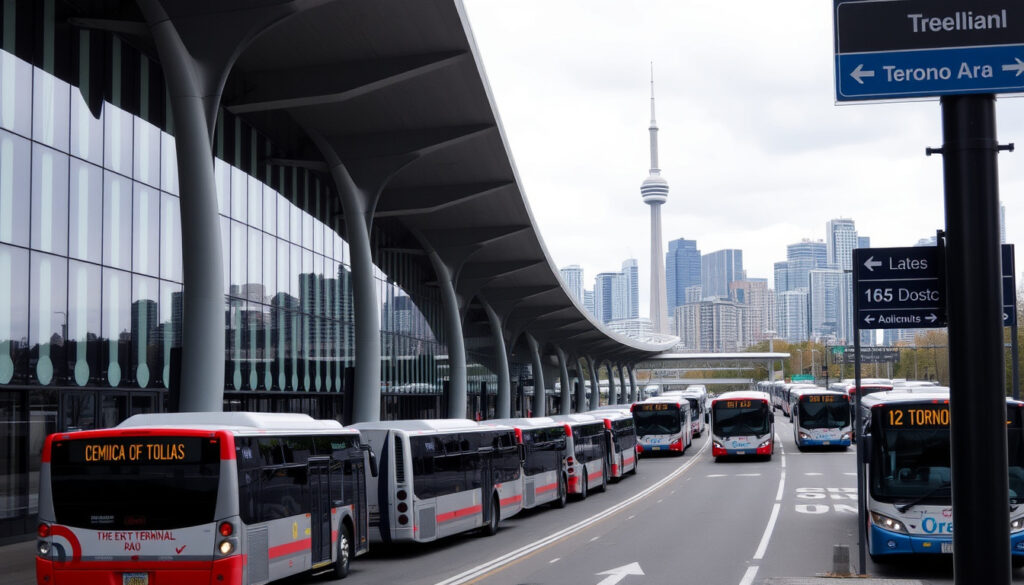
Union Station Bus Terminal Toronto: Location & Directions
Anyone who has ever dashed from a GO train to catch a bus knows that Toronto’s Union Station is not just a train hub — it’s a transit ecosystem. In December 2020, Metrolinx opened a new Union Station Bus Terminal at 81 Bay Street, replacing the aging surface lot and adding 14 covered bus bays. Below is a breakdown of where it is, how to get there, and what you need to know before your next trip.
Location: 81 Bay Street, 2nd Floor, Toronto · Opened: December 5, 2020 · Bus Bays: 14 · Hours: 5:00 AM – 2:50 AM daily · Amenities: Wi-Fi, washrooms, climate-controlled waiting area
Quick snapshot
- 81 Bay Street, 2nd floor, Toronto (GO Transit – Official Site)
- Open 5:00 AM – 2:50 AM daily (GO Transit)
- Connected to Union Station via indoor pedestrian bridge (Metrolinx)
- Greyhound (Greyhound)
- FlixBus (FlixBus)
- GO Transit (GO Transit)
- Free Wi‑Fi (GO Transit)
- Washrooms (GO Transit)
- Climate-controlled waiting area (GO Transit)
- Union Station (Metrolinx)
- Scotiabank Arena (Metrolinx)
- PATH network (Metrolinx)
The table below summarizes the terminal’s key specifications.
| Attribute | Detail |
|---|---|
| Year opened | 2020 |
| Number of bus bays | 14 |
| Daily ridership | Not publicly disclosed |
| Operator | GO Transit (Metrolinx) |
| Address | 81 Bay Street, 2nd floor, Toronto |
| Hours | 5:00 AM – 2:50 AM daily |
Where is the Union Station Bus Terminal in Toronto?
Address and exact location
- 81 Bay Street, 2nd floor, Toronto, ON (GO Transit – official map and address)
- Located at the north-east corner of Bay Street and Lake Shore Boulevard (GO Transit)
- Part of the CIBC Square development (Metrolinx – provincial transportation authority)
How to find the terminal within CIBC Square
- Main entrance on Lake Shore Boulevard, just east of Bay Street (GO Transit)
- Alternate entrance on the east side of Bay Street, across from Scotiabank Arena (GO Transit)
- Indoor pedestrian bridge over Bay Street connects to Scotiabank Arena, PATH, and Union Station (Metrolinx)
Access from Bay Street
- From Union Station concourse, follow signs to Bay Street exit (Metrolinx)
- Turn right on Bay Street and walk south toward Lake Shore Boulevard (Metrolinx)
- Terminal entrance on east side of Bay Street; take escalators up to second floor (YouTube guide – urban transit reviewer)
The indoor bridge over Bay Street is the game‑changer here: it means you never have to step outside, even on a freezing January evening, to move between the train terminal and the bus terminal.
The implication: Union Station Bus Terminal is effectively woven into the PATH system, making transfers weather‑proof and surprisingly fast for a complex of this size.
How do I get to Union Station Bus Terminal from Union Station?
Walking route from Union Station
- From the Main Concourse (at 65 Front Street), follow signs toward Bay Street / Scotiabank Arena (Metrolinx)
- Exit onto Bay Street through the doors near the York Concourse (Metrolinx)
- Turn right and walk south two blocks to Lake Shore Boulevard (GO Transit)
- Interior alternative: use the PATH walkway through the CIBC Square parking garage — you stay indoors the entire way (Metrolinx)
Directions via TTC subway
- Take Line 1 to Union Station (TTC – Toronto’s transit commission)
- From subway platform, follow “Bay Street/GO Concourse” signs up to the York Concourse (Metrolinx)
- From there, the same route as above
Driving and parking options
- No dedicated terminal parking; nearest paid lots at CIBC Square garage (entrance on Bay Street) (GO Transit)
- Alternatively, park at Green P lots south on Lake Shore Boulevard (GO Transit)
- Drop‑off zone available at the terminal entrance on Lake Shore Boulevard (GO Transit)
Drivers get proximity to the terminal, but the area is high‑traffic before events at Scotiabank Arena. Using TTC or GO train saves the $20+ parking fee and avoids the post‑event crawl.
The pattern: whether you come by subway, train, or private car, the terminal is designed for the pedestrian — not the driver. The few steps from transit far outweigh the cost and hassle of parking.
What is the difference between Greyhound and FlixBus?
Two major intercity carriers operate from Union Station Bus Terminal, yet their pricing models and onboard experience differ sharply. Below is a direct comparison drawn from their official policies and user reports.
| Feature | Greyhound | FlixBus |
|---|---|---|
| Ticket pricing model | Reserved seating, flat rates with some discounts (Greyhound – official pricing policy) | Dynamic pricing, often cheaper when booked in advance (FlixBus – FAQ section) |
| Onboard amenities | Wi‑Fi, power outlets, reclining seats, onboard restroom (Greyhound – bus features) | Wi‑Fi and power outlets on most buses, restroom on board (FlixBus – onboard services) |
| Service coverage | Largest network in Canada, including many small towns (Greyhound Canada routes) | Focus on major corridors: Toronto–Montreal, Toronto–Ottawa, Toronto–New York (FlixBus Canada routes) |
| Luggage allowance | One carry‑on + two checked bags, $20 fee for third (Greyhound – luggage policy) | One carry‑on + one checked bag included; additional fee for extra (FlixBus – luggage FAQ) |
What this means: if you book a week in advance and travel light, FlixBus usually wins on price. If you need broader route options or plan to transport bulky luggage, Greyhound gives more flexibility.
For a Toronto–Montreal trip booked 14 days ahead, FlixBus can be 40% cheaper than Greyhound’s flat rate — but a same‑day walk‑up fare may flip that equation entirely.
The comparison shows that advance booking favors FlixBus, while Greyhound offers more predictable pricing for walk-ups.
What is a terminal where buses arrive and depart?
Definition of a bus terminal
- A bus terminal is a designated facility where passengers board and alight intercity, commuter, or local transit buses (Wikipedia – user‑contributed encyclopedia)
- Unlike a simple bus stop, a terminal typically has multiple bays, ticket counters, waiting areas, and amenities (Wikipedia)
Components of a bus terminal
- Bus bays (designated loading positions), passenger waiting areas, ticket sales, washrooms, and sometimes retail (Wikipedia – bus station facilities)
- Modern terminals may also include climate control, digital departure boards, and indoor connections to other transit modes (GO Transit)
Union Station Bus Terminal as an example
- Features 14 bus bays, a climate‑controlled waiting area, free Wi‑Fi, washrooms, and digital departure screens (GO Transit)
- Indoor connection to the PATH network makes it a model for intermodal design (Metrolinx)
- Replaced a surface‑level bus station that had only 7 bays and exposed passengers to the elements (YouTube guide – urban transit reviewer)
The catch: a bus terminal is only as good as its connections. USBT succeeds because it plugs directly into trains, subway, and footpaths — not just because it has comfortable chairs.
What is the biggest bus station?
Largest bus stations in North America
- Port Authority Bus Terminal in New York City is the world’s busiest: 223 bays, serving 200,000 daily passengers (Port Authority of NY & NJ – official terminal page)
- Other large terminals: West 42nd Street – Port Authority Bus Terminal (Manhattan), Los Angeles Union Station (bus plaza) (Wikipedia – list of bus terminals)
How Union Station Bus Terminal compares
- With 14 bays, USBT is a mid‑sized facility by North American standards (Metrolinx)
- For context, Toronto Coach Terminal (the older terminal at 610 Bay Street) has 16 bays — similar capacity but aging infrastructure (Wikipedia – Toronto Coach Terminal)
- Port Authority Bus Terminal is roughly 16 times larger in bay count (Port Authority of NY & NJ)
Size and capacity of Union Station Bus Terminal
- 14 bus bays, two levels, designed for 8–10 buses per hour per bay at peak (Metrolinx)
- Exact daily passenger capacity not publicly disclosed (AmtrakTrains forum – rail enthusiast community)
- Currently serves GO Transit, Greyhound, FlixBus, and several smaller operators (GO Transit)
If passenger demand continues growing, the terminal’s 14 bays may become a bottleneck during peak travel weekends — something the old Toronto Coach Terminal already experienced.
The trade‑off: bigger isn’t always better. USBT’s advantage lies in its connectivity and indoor design, not raw size. For the average traveller, a comfortable 14‑bay terminal with seamless transit links beats a cavernous 223‑bay terminal that requires a 10‑minute walk to the train.
Confirmed facts
- Opened December 5, 2020 (Metrolinx)
- Address: 81 Bay Street (GO Transit)
- 14 bus bays (Metrolinx)
- Hours: 5:00 AM – 2:50 AM (GO Transit)
- Free Wi‑Fi, washrooms, climate‑controlled waiting area (GO Transit)
What’s unclear
- Exact daily passenger count not published (AmtrakTrains forum)
- Future expansion plans unknown — Metrolinx has not confirmed whether additional bays will be added (AmtrakTrains forum)
What riders are saying
The Union Station Bus Terminal offers a safe, comfortable and convenient space featuring a climate-controlled waiting area, Wi‑Fi, bathrooms and more.
— GO Transit (Metrolinx), official description on the transit agency’s website
The new terminal is completely indoors and much more convenient. The old one required walking along a platform exposed to the weather.
— Urban transit reviewer, comprehensive YouTube guide to Union Station
For Toronto travellers, the choice is clear: the Union Station Bus Terminal has raised the bar for intercity bus travel in the city. Whether you are a daily commuter or an occasional visitor, the terminal’s indoor connectivity, modern amenities, and streamlined design make it a far superior option to its predecessor. The real test will come when weekend traffic fully returns — but for now, this is a terminal that works.
gotransit.com, metrolinx.com, youtube.com, amtraktrains.com, toronto.ca
Travelers arriving at the terminal can easily connect to Montreal to Toronto bus services that depart regularly from the same facility.
Frequently asked questions
Can I purchase tickets at Union Station Bus Terminal?
Yes. Greyhound and FlixBus both have ticket counters inside the terminal, and digital kiosks are available for self‑service. You can also book online.
Is there Wi‑Fi at the terminal?
Yes, free Wi‑Fi is provided throughout the waiting area. Source: GO Transit.
Are there food options available?
The terminal itself does not have a food court, but vending machines are available. A Tim Hortons and other eateries are located within a 2‑minute walk inside Union Station.
How do I find my bus gate?
Digital departure screens are positioned throughout the terminal. Gates are announced approximately 15 minutes before departure and also shown on the GO Transit app.
Is there luggage storage?
No dedicated luggage storage is available at the terminal. Travelers must keep their bags with them at all times.
What is the phone number for the terminal?
The terminal is operated by GO Transit. General inquiries: 1‑888‑438‑6646 (GO Transit Customer Service).
Is the terminal accessible for wheelchairs?
Yes. The terminal is fully wheelchair accessible, with elevators, ramps, and accessible washrooms.
Can I park overnight?
Overnight parking is not provided at the terminal. Nearby Green P lots and the CIBC Square garage offer overnight parking for a fee.
Related reading
More related posts
 London Drugs Maple Ridge: Hours, Phone, Flyer & Services
 Super Kings vs Kings: Head-to-Head Record & Ban History
 Jaclyn Smith Biography: Age, Kids, Husband & Net Worth
 Louis XIV: The Sun King – Reign, Family, and Legacy
 NS Power Outage Map: Check Current Outages in Nova Scotia
 Why Rajat Bedi Left Bollywood: Downfall & Life Now
 Alexandr Wang: Net Worth, Age, and How He Became a Billionaire
