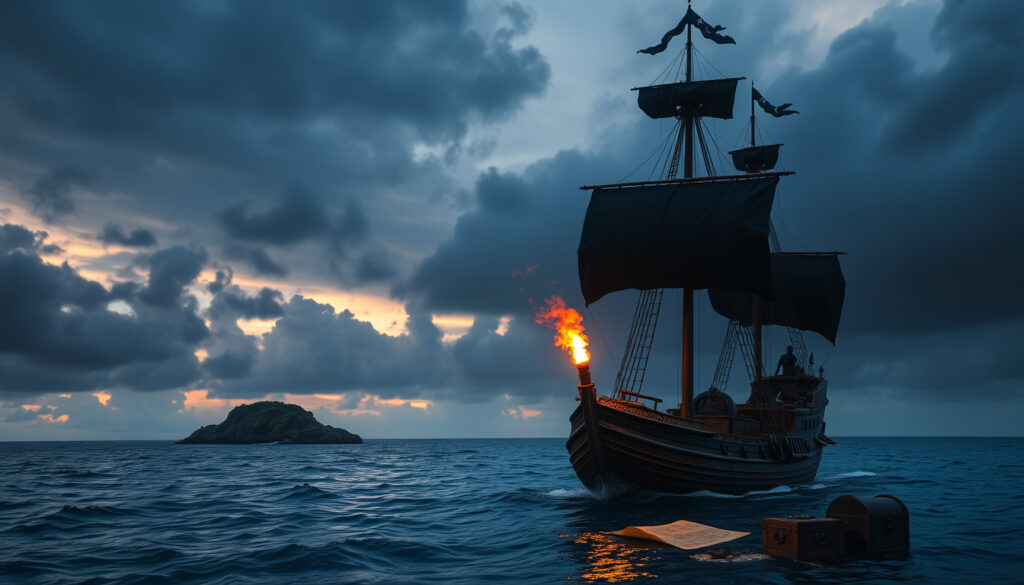
Edward Teach: The True Story of Blackbeard
Few figures from the age of piracy spark as much curiosity as Edward Teach, the man the world remembers as Blackbeard. His life was short, violent, and deliberately theatrical — and much of what we think we know about him is tangled in legend. This article separates documented fact from folklore, drawing on primary sources and archaeological evidence from the wreck of the Queen Anne’s Revenge.
Birth (approximate): c. 1680 · Date of death: November 22, 1718 · Ship commanded: Queen Anne’s Revenge · Gunshot wounds sustained in final battle: 5 · Stab wounds sustained: 20 · Treasure recovery status: Never recovered (confirmed missing)
Quick snapshot
- Killed in battle with British naval forces on November 22, 1718 (Britannica (encyclopedic reference))
- Captured the French slave ship La Concorde in late 1717 (Royal Museums Greenwich (maritime museum))
- Blockaded Charleston, South Carolina, in May 1718 (Smithsonian National Museum of American History (U.S. national museum))
- Exact birth location and date — estimates range from 1660 to 1680 (U.S. National Park Service (federal agency))
- Whether any direct descendants survive (NPS Cape Hatteras (U.S. national seashore))
- Authenticity of reported last words (U.S. National Park Service (federal agency))
- c. 1680 – Edward Teach born (likely Bristol, England) (Britannica (encyclopedic reference))
- 1716 – Joins pirate captain Benjamin Hornigold (Royal Museums Greenwich (maritime museum))
- Nov 22, 1718 – Killed at Ocracoke Island (U.S. National Park Service (federal agency))
- Archaeological work continues at the Queen Anne’s Revenge wreck site (NPS Cape Hatteras (U.S. national seashore))
- Blackbeard’s treasure has never been recovered (Wikipedia (community encyclopedia))
- Pop-culture portrayals continue to shape public perception (NPS Cape Hatteras (U.S. national seashore))
Seven key facts about Edward Teach, drawn from government archives and historical societies, give a consistent outline of his life and death.
Here are the confirmed biographical details:
| Attribute | Detail |
|---|---|
| Real name | Edward Teach (or Thatch) (Royal Museums Greenwich (maritime museum)) |
| Born | c. 1680, possibly Bristol, England (Britannica (encyclopedic reference)) |
| Died | November 22, 1718, Ocracoke Island, North Carolina (U.S. National Park Service (federal agency)) |
| Nickname | Blackbeard (Smithsonian National Museum of American History (U.S. national museum)) |
| Ship(s) | Queen Anne’s Revenge, Adventure (Royal Museums Greenwich (maritime museum)) |
| Cause of death | Gunshot and stab wounds in battle (Smithsonian National Museum of American History (U.S. national museum)) |
| Known for | Blockade of Charleston, fearsome appearance, pirate career (Britannica (encyclopedic reference)) |
What is Edward Teach famous for?
Who was Edward Teach?
Edward Teach — sometimes spelled Thatch in early records — was an English pirate who operated in the West Indies and along the eastern coast of Britain’s North American colonies (Britannica (encyclopedic reference)). He is best known for his deliberately terrifying appearance, his flagship the Queen Anne’s Revenge, and the five-day blockade of Charleston, South Carolina, in May 1718 (Smithsonian National Museum of American History (U.S. national museum)).
Why is Blackbeard considered a legendary pirate?
Blackbeard’s notoriety comes from both his brief, intense career and the enduring mythos that grew after his death. His pirate career likely spanned only about two years — roughly 1716 to 1718 (Royal Museums Greenwich (maritime museum)) — yet in that time he captured dozens of merchant vessels and controlled a small fleet (Smithsonian National Museum of American History (U.S. national museum)). The violence of his death — 5 gunshot wounds and 20 stab wounds — sealed his status.
What are the most common myths about Blackbeard?
- That he buried treasure: no verified treasure has ever been found (Wikipedia (community encyclopedia)).
- That his last words were a defiant curse: no contemporary source records them.
- That he had many wives: records show he married a local woman in North Carolina named Mary Ormond, but evidence for other claims is thin.
The implication: Blackbeard’s legend rests on a very small window of real events, amplified by the early 18th-century press and later romantic fiction.
How many times was Blackbeard shot before he died?
What injuries did Blackbeard sustain in the battle?
According to the first printed account — the Boston News-Letter of February 1719, as preserved in later compilations — Blackbeard received five gunshot wounds and about twenty stab wounds before he fell (Smithsonian National Museum of American History (U.S. national museum)). The battle took place on the morning of November 22, 1718, off Ocracoke Island, North Carolina (U.S. National Park Service (federal agency)).
How did Lieutenant Robert Maynard’s crew defeat Blackbeard?
Lieutenant Robert Maynard, commanding two hired sloops HMS Ranger and HMS Jane, cornered Blackbeard at anchor near Ocracoke Inlet. The pirates opened fire with cannons loaded with grapeshot, disabling one of Maynard’s sloops. Maynard then hid most of his crew below deck and lured Blackbeard to board, at which point his sailors rushed up and overwhelmed the pirates in hand-to-hand combat (Smithsonian National Museum of American History (U.S. national museum)). Maynard later brought Blackbeard’s head back to Virginia to claim a £100 reward.
What this means: the battle was less about cannon duels and more about a tactical ambush that exploited Blackbeard’s overconfidence.
What were Blackbeard’s last words?
Are Blackbeard’s last words accurately recorded?
No definitive primary source records Blackbeard’s actual last words. The earliest printed descriptions, including Maynard’s own report, describe a fierce fight but include no dying speech (Smithsonian National Museum of American History (U.S. national museum)).
What did Maynard report about the encounter?
Maynard’s official letter to the Governor of Virginia, reprinted in the Boston News-Letter, focuses on the tactical sequence and casualties. The famous line “Damnation seize my soul if I give you quarters, or take any from you” appears in Captain Charles Johnson’s A General History of the Pyrates (1724), written a few years after the event. Johnson’s account, though vivid, is a secondary source of uncertain reliability (World History Encyclopedia (historical reference)).
The pattern: when no eyewitness recorded the words, later authors supplied them — and readers kept the most dramatic version.
How did Edward Teach become Blackbeard?
What was Edward Teach’s early life and privateering career?
Teach likely served as a privateer during Queen Anne’s War (1701–1714), attacking enemy ships under a royal commission (U.S. National Park Service (federal agency)). After the war ended, many former privateers turned to piracy because they lacked legal employment.
When did Teach begin his pirate career?
- Late 1716 – joins pirate captain Benjamin Hornigold (Royal Museums Greenwich (maritime museum))
- Late 1717 – captures the French slave ship La Concorde and renames it Queen Anne’s Revenge (Smithsonian National Museum of American History (U.S. national museum))
- May 1718 – blockades Charleston, holding hostages for a chest of medicine (Britannica (encyclopedic reference))
- June 1718 – the Queen Anne’s Revenge grounds on a sandbar at Topsail Inlet (now Beaufort Inlet, North Carolina) (NPS Cape Hatteras (U.S. national seashore))
The catch: Teach’s career as a pirate captain lasted barely 15 months by some estimates (World History Encyclopedia (historical reference)), yet those months made him the most famous pirate in Anglo-American history.
Why did Teach call himself Blackbeard?
What was Teach’s physical appearance?
Contemporary accounts describe him as a tall, lean man with a thick, jet-black beard that he allowed to grow long and wild. He braided black ribbons into its strands and, before battle, tucked slow-burning fuses under his hat to frame his face in smoke (Smithsonian National Museum of American History (U.S. national museum)).
Did he use props to enhance his fearsome image?
Yes. The fuses, the ribbons, and the deliberate display were tactical. As one early historian wrote, “He intended to strike terror into the hearts of those who saw him” — and it worked. Many merchant crews surrendered without a fight (Royal Museums Greenwich (maritime museum)).
The trade-off: his image was a weapon, but it also made him a target for the naval officers who hoped to collect the reward on his head.
What did Blackbeard do with slaves?
Did Blackbeard trade slaves?
Blackbeard captured multiple slave ships, most notably the French vessel La Concorde, which he converted into the Queen Anne’s Revenge. Historical records show he sometimes sold the enslaved captives and at other times forced them to work as crew members (Royal Museums Greenwich (maritime museum)).
How did the slave trade feature in Blackbeard’s operations?
The transatlantic slave trade was a dominant industry in the Caribbean and American colonies during the early 1700s. Pirates like Teach were not moral abolitionists — they participated in the trade when it was profitable. One of his ships, the Adventure, was a former slave vessel (NPS Cape Hatteras (U.S. national seashore)).
What happened to the enslaved people on captured ships?
Some were kept; some were sold; some were set ashore. After Blackbeard’s death, the fate of the enslaved people aboard his remaining sloop is not well documented, though some were likely returned to slave traders or re-sold.
The implication: Blackbeard was a product of his time — a ruthless opportunist who operated within the slave economy, not outside it.
Timeline of Edward Teach’s life
- c. 1680 – Edward Teach born, likely in Bristol, England (Britannica (encyclopedic reference))
- 1701–1714 – Serves as a privateer during Queen Anne’s War (U.S. National Park Service (federal agency))
- Late 1716 – Joins pirate captain Benjamin Hornigold (Royal Museums Greenwich (maritime museum))
- Late 1717 – Captures French slave ship La Concorde, renames her Queen Anne’s Revenge (Smithsonian National Museum of American History (U.S. national museum))
- May 1718 – Blockades Charleston, South Carolina (Britannica (encyclopedic reference))
- June 1718 – Queen Anne’s Revenge grounds at Topsail Inlet (NPS Cape Hatteras (U.S. national seashore))
- November 22, 1718 – Killed in battle with Lieutenant Robert Maynard (U.S. National Park Service (federal agency))
Separating confirmed facts from unresolved questions
Confirmed facts
- Death on November 22, 1718 at Ocracoke Inlet (Britannica (encyclopedic reference))
- Suffered 5 gunshot and 20 stab wounds (Smithsonian National Museum of American History (U.S. national museum))
- Captured the French slave ship La Concorde (Royal Museums Greenwich (maritime museum))
- Blockaded Charleston in May 1718 (Britannica (encyclopedic reference))
What’s unclear
- Exact birth location and date (U.S. National Park Service (federal agency))
- Where his treasure (if any) is hidden (Wikipedia (community encyclopedia))
- Whether any direct descendants survive (NPS Cape Hatteras (U.S. national seashore))
- Authenticity of his reported last words (World History Encyclopedia (historical reference))
“He was a tall, spare man with a very black beard which he suffered to grow excessively.”
— Captain Charles Johnson (pseudonym, likely Nathaniel Mist), A General History of the Pyrates, 1724 (World History Encyclopedia (historical reference))
“Maynard gave chase and came up with the pirate; a desperate engagement ensued, and Blackbeard fell after receiving five gunshot wounds and about twenty cuts.”
— Adapted from Boston News-Letter, February 1719, as cited by the Smithsonian (Smithsonian National Museum of American History (U.S. national museum))
Related reading: **Louis XIV: The Sun King – Reign, Family, and Legacy** · **Franz Kafka: Life, Works, and Enduring Influence**
ebsco.com, id.wikipedia.org, ncpedia.org, qaronline.org, thehistorypress.co.uk
For a deeper dive into the historical facts behind the legend, read the true story of Blackbeard.
Frequently Asked Questions
When was Blackbeard born?
Blackbeard was likely born around 1680, possibly in Bristol, England, but the exact year and place are uncertain (Britannica (encyclopedic reference)). Some sources, including the U.S. National Park Service, suggest a range from 1660 to 1680 (U.S. National Park Service (federal agency)).
Where did Blackbeard die?
Blackbeard was killed on November 22, 1718, at Ocracoke Island, North Carolina (U.S. National Park Service (federal agency)).
What was the name of Blackbeard’s pirate ship?
His flagship was the Queen Anne’s Revenge, originally a French slave ship called La Concorde (Royal Museums Greenwich (maritime museum)).
How long was Blackbeard active as a pirate?
His pirate career lasted roughly two years, from about 1716 to 1718 (Royal Museums Greenwich (maritime museum)). Some estimates put his captaincy at barely 15 months (World History Encyclopedia (historical reference)).
Did Blackbeard have a wife?
Records show he married a local woman in North Carolina named Mary Ormond. Claims of multiple wives come from later fiction and lack contemporary evidence.
What happened to Blackbeard’s crew after his death?
Most of Blackbeard’s surviving crew were captured and tried in Virginia. Several were executed, while others received lighter sentences or were acquitted.
Is Blackbeard’s treasure still missing?
Yes, no verified treasure has ever been found (Wikipedia (community encyclopedia)).
More related posts
 Forza Horizon 6 Release Date – May 19 2026 Confirmed Details
 Best Arena 15 Deck Clash Royale – Meta Decks With 55% Win Rates
 How Old Is Holly Wheeler in Stranger Things Season 5?
 Fat Guys Auto Parts: Reviews, Prices, Winnipeg Location
 Inter Milan vs Fluminense FC Lineups: Confirmed Starting XIs
 Penny Oleksiak: Ban, Gender, and Olympic Career Explained
 Alex Pretti: Verified Facts on the VA Nurse Shooting
 Why Daft Punk Broke Up: Full Story, Face Reveal & Friendship – 2025
