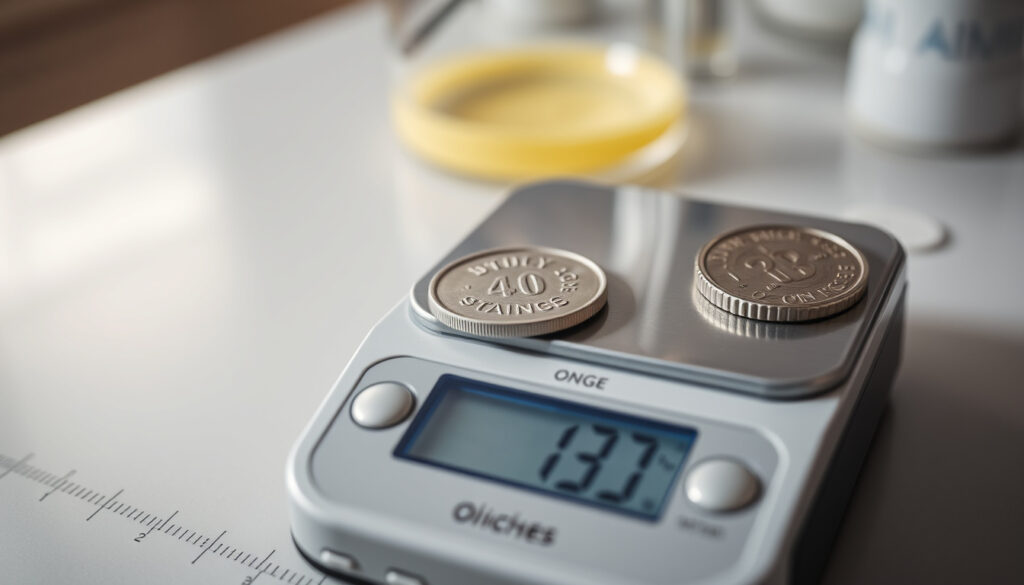
1 Ounce to Grams Conversion: Standard vs Troy Ounce Explained
If you’ve ever tried to convert an ounce to grams and ended up with two different numbers, you’re not alone: one ounce of your breakfast cereal weighs about 28.35 grams, but one ounce of gold clocks in at 31.1 grams — the confusion lies in the system of measurement, not the scale. This guide clears up exactly how many grams are in an ounce, why precious metals use a different standard, and how to convert confidently every time.
1 standard ounce (oz): 28.3495 g ·
1 troy ounce (ozt): 31.1035 g ·
Common approximation: 1 oz ≈ 28.35 g ·
Gold spot price per troy ounce (24K, Oct 2023): $1,832
Quick snapshot
- Used for food and everyday items — 1 oz = 28.3495 g (Bullion Standard (bullion education site))
- Common in US customary system (Wikipedia — Avoirdupois weight)
- Used for gold, silver, platinum — 1 ozt = 31.1035 g (BullionVault (precious metals trading platform))
- Heavier than standard ounce by about 9.7% (Wikipedia — Troy weight)
- Multiply ounces by 28.35 to get grams (standard) (StoneX Bullion (bullion dealer and educator))
- For gold, multiply by 31.1 (StoneX Bullion (bullion dealer and educator))
- 1/8 oz = 3.5 g (standard) (StoneX Bullion (bullion dealer and educator))
- 30 grams is not equal to 1 standard ounce (Wikipedia — Troy weight)
- It’s close to 1 troy ounce (31.1 g) but still off by 1.1 g (Wikipedia — Troy weight)
Five conversion facts, one pattern: the troy system is the outlier, and the difference matters most when dealing with precious metals.
| Label | Value |
|---|---|
| 1 oz (standard) to grams | 28.3495 g |
| 1 troy oz to grams | 31.1035 g |
| Gold price per troy oz (24K, Oct 2023) | $1,832 |
| Common approximation | 28 g per oz (less precise) |
| 1/8 oz in grams | 3.5437 g |
| 1 troy oz in standard ounces | 1.0971 oz |
| Troy oz in grains | 480 grains |
| Standard oz in grains | 437.5 grains |
| Gold purity (24K) per troy oz | 99.99% pure |
For more conversion tools, see our Conversion livre en kg guide.
How Many Grams Are in 1 Ounce?
Standard (avoirdupois) ounce conversion
- One standard (avoirdupois) ounce equals exactly 28.349523125 grams — commonly rounded to 28.3495 g (Bullion Standard (conversion reference)).
- This is the ounce used for groceries, body weight, and most everyday measurements in the United States.
- For quick mental math, multiply by 28.35 — or use 28 g for rough estimates (about 1.2% error).
The pattern: the standard ounce is the baseline for daily life, and its gram equivalent is fixed by international agreement. The catch: this is not the ounce used for gold, as we’ll see next.
Is 30 Grams Equal to 1 Ounce?
Why 30 g is not exactly 1 oz
No, 30 grams is not equal to 1 standard ounce. The math: 30 g ÷ 28.3495 g/oz = about 1.058 ounces. So 30 grams is roughly 1.06 standard ounces — a small but meaningful overage, especially in cooking or chemistry.
Common approximation errors
- Some sources round 1 oz to 28 g, which makes 30 g seem like “close enough” — but it’s off by 7%.
- 30 grams is much closer to a troy ounce (31.1 g), but still 1.1 g short. As StoneX Bullion (precious metals educator) explains, this confusion arises when people mix the two systems.
The trade-off: using 30 g as a shortcut for either ounce creates errors that compound in large quantities.
How Many Grams Is 1 Ounce of 24K Gold?
Troy ounce vs standard ounce for precious metals
- Gold is always measured in troy ounces, not standard ounces — 1 troy ounce of 24K gold equals 31.1034768 grams (Wikipedia — Troy weight (reference on historical measures)).
- This is approximately 31.1035 g, or about 10% heavier than a standard ounce.
- The troy ounce is the global standard for gold, silver, platinum, and palladium pricing (BullionVault (precious metals platform)).
- As of October 2023, the spot price for 24K gold is approximately $1,832 per troy ounce.
Why this matters: if a dealer quoted gold in standard ounces, the price would appear about 10% lower — but you’d get less metal. Always confirm whether the quote uses troy ounces.
Why is 1 oz gold 31 grams?
Origin of the troy weight system
- The troy system dates back to medieval Europe, likely named after the French city of Troyes, a major trading hub for precious metals and gems.
- One troy ounce equals 480 grains, while a standard ounce equals 437.5 grains — the grain is the same unit (64.79891 mg since 1959) (Wikipedia — Troy weight (historical foundation)).
- Because bullion markets continued using troy ounces after the avoirdupois system became standard for everything else, the two systems diverged.
- The 31.1035 g figure comes directly from 480 × 64.79891 mg, then converted to grams (BullionVault (grain-to-gram conversion)).
An investor buying gold gets 10% more metal per ounce than someone buying flour from the same scale — simply because the definition of “ounce” changes with the commodity. The rule: food uses standard, gold uses troy.
The implication: every extra grain in the troy system adds up: at current prices, that 10% difference means about $183 per troy ounce of gold compared to a standard ounce.
How to Convert Ounces to Grams (Step by Step)
Identify which ounce you have
- If the item is food, body weight, or a common household product, it’s a standard (avoirdupois) ounce.
- If the item is a precious metal (gold, silver, platinum, palladium), it’s a troy ounce.
Apply the correct conversion factor
- Standard ounce → grams: multiply by 28.3495. For 3 oz: 3 × 28.3495 = 85.0485 g.
- Troy ounce → grams: multiply by 31.1035. For 3 ozt: 3 × 31.1035 = 93.3105 g (Bullion Standard (example conversion)).
Use a reliable calculator or table
- Online converters like The Calculator Site (conversion tools) provide quick tables: 1 oz = 0.9115 troy oz; 10 oz = 9.1146 troy oz.
- For frequent conversions, memorize the approximations: 28 g per standard oz, 31 g per troy oz.
Double-check your result
- If your number seems too high or too low, you likely used the wrong ounce type. A troy ounce should yield about 10% more grams than a standard ounce.
Warning: Using the wrong ounce type in a gold transaction can lead to a 10% error in the amount of metal you receive. Always confirm the unit with your dealer.
What this means: the cost of a conversion mistake is highest with precious metals — a 10% error on a 1 kg gold bar (≈32.15 troy oz) at $1,832/oz means a $5,900 swing.
For another weight conversion reference, check our 3/4 Cup Butter to Grams guide.
Confirmed facts
- 1 standard ounce = 28.3495 grams (Bullion Standard)
- 1 troy ounce = 31.1035 grams (Wikipedia)
- 30 grams is not equal to 1 standard ounce (it’s 1.058 oz)
- A troy ounce is about 9.7% heavier than a standard ounce (Wikipedia)
- Gold is priced per troy ounce globally (BullionVault)
What’s unclear
- Why the word “ounce” was kept for two drastically different systems — the historical reasons are tied to medieval trade routes, but no single document explains the divergence clearly.
- The precise date of the adoption of the troy system in gold trading is uncertain.
- The reason why the grain was chosen as the base unit for troy weight is not fully explained.
“A troy ounce is about 9.7% heavier than an avoirdupois ounce, which is why gold does not convert using the same factor as flour or sugar.”
— Wikipedia — Troy weight (reference on unit history)
“One troy ounce is equivalent to approximately 1.097 standard (avoirdupois) ounces, making it the standard mass unit for precious metals in industry and trade.”
— StoneX Bullion (bullion education article)
“The troy ounce is used to weigh precious metals such as gold, silver, platinum, and palladium. One troy ounce equals 480 grains.”
The consequence for anyone buying or selling gold: using the wrong ounce type changes the transaction value by nearly 10%. For a bullion buyer in the UK or US, the choice is clear: always ask “troy or standard?” before agreeing to a price, or risk paying $183 extra per ounce for the same metal.
For a detailed breakdown of the differences between the two measuring systems, see this guide on standard vs. troy ounce conversion.
Frequently asked questions
How do I convert ounces to grams quickly?
Multiply ounces by 28.35 for standard (avoirdupois) ounces, or by 31.1 for troy ounces. Use a calculator for exact figures.
What is the difference between a troy ounce and a standard ounce?
A troy ounce (31.1035 g) is about 9.7% heavier than a standard ounce (28.3495 g). Troy ounces are used for precious metals; standard ounces for everyday items.
Why is gold measured in troy ounces?
Historically, the troy system (named after Troyes, France) became the standard for trading gold, silver, and gems. The convention persists in bullion markets worldwide.
How many grams are in 1/4 ounce?
1/4 standard ounce = 7.0874 g (divide 28.3495 by 4). 1/4 troy ounce = 7.7759 g.
Is 28 grams equal to 1 ounce?
Very close — 1 standard ounce = 28.3495 g, so 28 g is about 1.2% less. For most cooking, 28 g is used as a rounded equivalent.
How much is 1 ounce of 24K gold worth?
As of October 2023, 1 troy ounce of 24K gold was trading around $1,832. Prices fluctuate daily.
How many grams are in 4 ounces?
4 standard ounces = 113.398 g (4 × 28.3495). 4 troy ounces = 124.414 g.
How many grams are in 8 ounces?
8 standard ounces = 226.796 g. 8 troy ounces = 248.828 g.
More related posts
 Kelly McGillis: Life, Weight Loss & Why She Left Acting
 Isa Briones: Ethnicity, Family, Career & Controversy
 Pneu a Rabais St Jerome – Discount Tires Deals and Promotions
 Commission Scolaire des Samares – Schools, Contacts & Overview
 Rainn Wilson: Biography, Net Worth, and The Office
 Dominic Fike: Biography, Euphoria Exit, Fatherhood, and More
 Daniel Radcliffe: from Harry Potter to fatherhood and feud
 Algérie – RD Congo 1-0: Boulbina’s AFCON Decider
