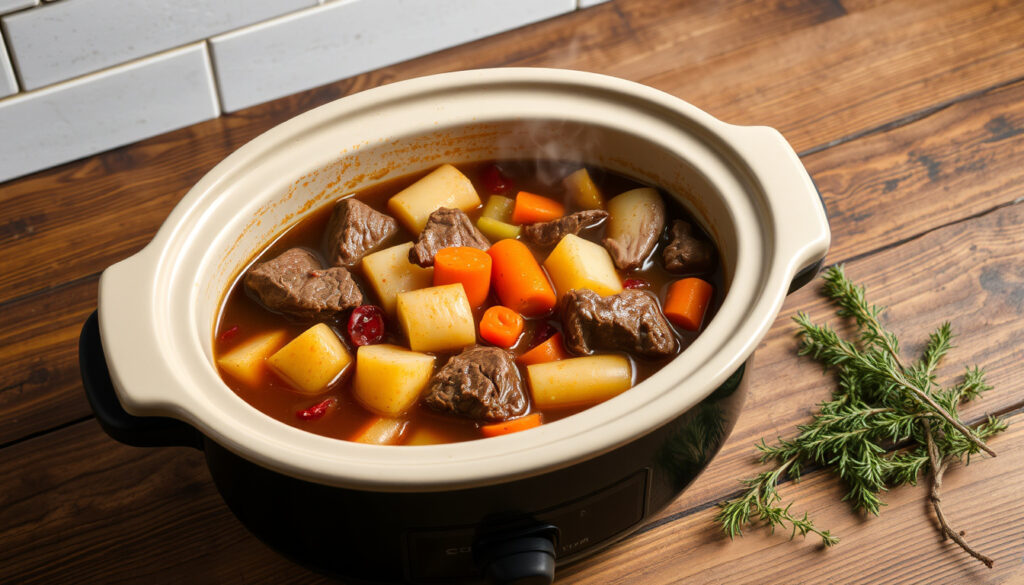
How to Make Slow Cooker Beef Stew: Tips and Recipe
Anyone who’s ever stood over a stovetop after a long day, waiting for a stew to come together, knows the appeal of a slow cooker: dump in the ingredients, walk away, and return hours later to a meal that tastes like you fussed. But the question that divides home cooks—whether to brown the meat first—isn’t just about tradition; it’s about chemistry. This guide settles the debate and walks you through every step to make a slow cooker beef stew that’s tender, flavorful, and foolproof.
Average cook time on low: 8-10 hours (Lexi’s Clean Kitchen (whole30 food blog)) ·
Average cook time on high: 4-5 hours (Savory Nothings (recipe developer)) ·
Essential base ingredients: 4 (beef, broth, vegetables, seasoning) ·
Browning step recommended by: Majority of top recipes (Ambitious Kitchen (health-focused food blog))
Quick Snapshot
- Slow cooking on low for 8-10 hours breaks down collagen for tender meat (Lexi’s Clean Kitchen)
- Browning adds flavor via Maillard reaction (Ambitious Kitchen)
- At least 1/2 cup liquid necessary for steam (Savory Nothings)
- Raw beef is safe to place directly in slow cooker (The Country Cook)
- Optimal liquid amount varies by recipe and slow cooker model
- Exact effect of high vs low on tenderness depends on cut
- Whether skipping browning saves enough time to offset flavor loss
- Optimal beef chunk size for even cooking varies by recipe
- Typical cook times: low 8-10 hours, high 4-5 hours (Savory Nothings)
- Browning step adds ~15 minutes prep time (Savory Nothings)
- Add delicate vegetables (peas, green beans) in last 30 minutes (Savory Nothings)
- Serve with crusty bread or over mashed potatoes
- Store leftovers for up to 4 days in airtight container
- Freeze in portions for up to 3 months
Five key facts stand out from the research, one pattern: every trusted recipe agrees on the core pillars—but they split on the browning debate.
| Fact | Detail |
|---|---|
| Main ingredient | Beef chuck (braising steak) |
| Cook time (low) | 8-10 hours (Lexi’s Clean Kitchen) |
| Cook time (high) | 4-5 hours (Savory Nothings) |
| Minimum liquid | 1/2 cup for steam generation |
| Browning benefit | Flavor and color (not safety) |
| Browning method | Sear in oil over medium-high heat, in batches (Ambitious Kitchen) |
| Deglazing technique | Scrape browned bits with red wine or broth (Savory Nothings) |
| Thickening method | Flour or cornstarch coating before browning, or slurry at end (The Country Cook) |
| Extra flavor boost | Tomato paste, tapioca, Worcestershire, red wine (Lexi’s Clean Kitchen) |
What are the 4 ingredients in beef stew?
Essential beef cuts for stew
Choose braising steak or chuck—cuts with marbling that break down into tenderness over long cooking. Lexi’s Clean Kitchen (whole30 food blog) uses 2 pounds of beef stew meat, while The Country Cook (homestyle recipe blog) recommends the same amount. Lean cuts from the round will turn out dry and stringy.
Core vegetables and aromatics
Onions, carrots, and celery form the classic mirepoix base. Potatoes are optional—some recipes add them at the start, others prefer to serve the stew over mashed potatoes. Ambitious Kitchen (health-focused food blog) includes frozen peas stirred in during the last 10 minutes of cooking.
Broth and liquid base
Beef broth or stock is standard. Savory Nothings (recipe developer blog) adds red wine and Worcestershire sauce for depth. Lexi’s Clean Kitchen uses tomato paste as part of the liquid base, which also contributes umami and helps thicken.
Seasoning and herbs
Thyme, bay leaf, salt, and pepper are universal. Some recipes add garlic, rosemary, or a pinch of smoked paprika. The combination is simple but essential—without seasoning, even the best beef falls flat.
The pattern: the four pillars—beef, vegetables, liquid, seasoning—are non-negotiable. Every variation is a riff on that framework.
Using a cheaper cut like chuck means you trade a longer cook time for a richer, more gelatinous broth—the kind that coats your spoon.
Do you have to brown stew meat before putting it in the crockpot?
Maillard reaction and flavor impact
Browning triggers the Maillard reaction, which produces hundreds of flavor compounds. Ambitious Kitchen (health-focused food blog) sears the beef in batches for about 5 minutes per batch. A YouTube tutorial (home cook video) says it “builds flavor,” but acknowledges skipping it still yields a good stew.
Texture differences with and without browning
Unbrowned beef may lack the deep color and crust that browning provides, but it will still become tender. The key difference is in the gravy: browned meat leaves fond (browned bits) that enrich the liquid. Savory Nothings (recipe developer blog) deglazes the skillet with red wine or broth to capture that fond.
Time-saving alternative steps
If you skip browning, consider adding a splash of soy sauce or Worcestershire for a savory boost. You can also use flour or cornstarch coating to help thicken the stew, as The Country Cook (homestyle recipe blog) demonstrates.
The catch: browning adds about 15 minutes of active prep. For a 8-hour cook, that time investment pays back in flavor—but if you’re truly pressed, the stew will still be edible and tender.
Do I need to put liquid in the slow cooker with beef?
Minimum liquid requirements for slow cooking
Yes—at least 1/2 cup of liquid is needed to create steam and prevent burning. The slow cooker relies on steam to distribute heat evenly. Savory Nothings (recipe developer blog) uses a total liquid volume that covers about two-thirds of the ingredients.
How much broth to add
Most recipes call for 2–3 cups of beef broth. Lexi’s Clean Kitchen (whole30 food blog) includes tomato paste and tapioca to thicken without excess liquid. The exact amount matters less than the ratio—aim for just enough to reach the top of the meat and vegetables.
What happens with too little liquid
Too little liquid can cause scorching on the bottom, especially if the cooker runs hot. The Country Cook (homestyle recipe blog) notes that a 5-6 quart slow cooker handles a standard stew batch comfortably with about 1 cup of liquid beyond what the vegetables release.
What this means: you don’t need to drown the stew—the meat and vegetables release juices—but don’t skimp below the minimum.
Adding too much liquid dilutes the final gravy. You’ll end up with soup instead of stew—and you can’t easily boil it down in a slow cooker.
How to slow cook beef in a slow cooker?
Preparing the beef and vegetables
Cut beef into uniform 1–2 inch chunks. Pat dry with paper towels to help browning. Lexi’s Clean Kitchen (whole30 food blog) seasons the meat with salt and pepper before searing. Prepare vegetables by peeling and chopping carrots, onions, and celery into similar-sized pieces.
Layer order in the slow cooker
Place root vegetables—carrots, potatoes, onions—on the bottom. They take longer to cook and benefit from sitting closer to the heat source. The beef goes on top, followed by the liquid and seasonings. Ambitious Kitchen (health-focused food blog) adds peas only in the last 10 minutes to keep them bright.
Cook time settings and temperature
Cook on low for 8-10 hours or high for 4-5 hours. The low setting reaches approximately 200°F, while high sits around 300°F (Wikipedia (general reference)). Savory Nothings (recipe developer blog) and The Country Cook (homestyle recipe blog) both default to 8 hours on low. The low-and-slow method breaks down collagen more thoroughly, yielding fork-tender meat.
The trade-off: high heat saves time but may leave meat slightly less tender. For tough cuts like chuck, low is almost always better.
What are common mistakes in slow cooking beef?
Overcrowding the slow cooker
Filling the slow cooker more than two-thirds full slows heat circulation and leads to uneven cooking. The YouTube tutorial (home cook video) recommends cooking in batches if you double the recipe. A standard 5-6 quart slow cooker handles a single batch of 2 pounds of beef with vegetables comfortably (Savory Nothings).
Adding dairy too early
Milk, cream, or cheese should be added in the last 30 minutes. If added at the start, they curdle or separate. The Country Cook (homestyle recipe blog) avoids dairy entirely in its classic stew recipe.
Lifting the lid during cooking
Each time you lift the lid, heat escapes and adds 20 minutes of cooking time. Savory Nothings (recipe developer blog) advises keeping the lid on until at least the 4-hour mark for low cooking.
Using lean cuts of beef
Lean cuts like sirloin or round become dry and tough after hours of cooking. Braising steak or chuck—with its marbling—is the only choice. Lexi’s Clean Kitchen (whole30 food blog) and Ambitious Kitchen (health-focused food blog) both call for chuck or stew meat labeled “for stew.”
Why this matters: each mistake can turn a promising stew into a disappointment. The good news is they’re all easy to avoid with a little planning.
Is 4 hours on high the same as 8 hours on low?
Temperature differences between high and low settings
Low setting typically runs at about 200°F, high at about 300°F. The higher temperature speeds up cooking but does not simply cut time in half due to the need for collagen breakdown. Savory Nothings (recipe developer blog) emphasizes that low heat gives a more forgiving window.
Effect on meat tenderness
Tough cuts like chuck require time for collagen to convert to gelatin. Eight hours on low provides that time; four hours on high may leave meat firmer. Ambitious Kitchen (health-focused food blog) warns that high can work if you’re pressed, but low is preferred for fork-tender results.
Best practices for timing
If using high, check tenderness at 4 hours; if not done, continue on low. The majority of recipe developers default to low for reliability. The Country Cook (homestyle recipe blog) states that low consistently yields more tender meat across different slow cooker models.
The implication: while high can save time, low is safer for texture. Know your slow cooker’s hot spots and adjust accordingly.
Can I put raw beef straight into a slow cooker?
Food safety guidelines
Yes, raw beef is safe to place directly in the slow cooker. The slow cooker reaches a safe internal temperature (above 140°F) well within the 2-hour food safety window. The Country Cook (homestyle recipe blog) confirms this is safe and commonly done by many cooks.
Flavor and texture trade-offs
Raw beef that goes in without searing will still become tender, but the finished stew lacks the deep color and rich crust of browned meat. The Maillard reaction is missing, so the broth will be lighter in flavor. Savory Nothings (recipe developer blog) notes that skipping browning sacrifices flavor depth.
Recommended preparation steps
If you choose to skip browning, pat the beef dry and season well. Add a splash of Worcestershire or soy sauce to compensate. Layer vegetables on bottom, beef on top, and add liquid. The YouTube tutorial (home cook video) reassures that the stew will still be good, just less complex.
The catch: skipping browning saves about 15 minutes of prep but costs flavor. For a cook who values efficiency over depth, raw beef works fine.
Step-by-Step Guide to Slow Cooker Beef Stew
- Prep the beef: Cut 2 lbs chuck into 1-2 inch chunks. Season with salt and pepper. (Optional: dredge in 1/4 cup flour.)
- Brown the beef (optional but recommended): Heat 2 tbsp oil in a skillet over medium-high. Brown beef in batches, about 5 minutes per batch (Ambitious Kitchen). Transfer to slow cooker.
- Deglaze skillet: Pour 1/2 cup red wine or beef broth into the hot skillet. Scrape up browned bits. Pour over beef (Savory Nothings).
- Layer vegetables: Place chopped carrots, onions, celery (and potatoes if using) on bottom of slow cooker. Add beef on top.
- Add liquids: Pour 2 cups beef broth, 2 tbsp tomato paste, 1 tbsp Worcestershire sauce, and any herbs (thyme, bay leaf). Stir gently.
- Cook: Cover and cook on low for 8-10 hours or high for 4-5 hours. Do not lift the lid unnecessarily.
- Thicken (optional): In the last 30 minutes, whisk 2 tbsp cornstarch with 2 tbsp cold water and stir into stew. Cook uncovered to thicken (YouTube tutorial).
- Finish and serve: Stir in frozen peas (if using) and let sit 5 minutes. Remove bay leaf. Ladle into bowls and serve.
Clarity Check: What’s Settled and What’s Not
Confirmed facts
- Slow cooking on low for 8-10 hours breaks down collagen for tender meat (Lexi’s Clean Kitchen)
- Browning adds flavor via Maillard reaction (Ambitious Kitchen)
- At least 1/2 cup liquid necessary for steam (Savory Nothings)
- Raw beef is safe to place directly in slow cooker (The Country Cook)
What’s unclear
- Optimal liquid amount varies by recipe and slow cooker model
- Exact effect of high vs low on tenderness depends on specific cut
- Whether skipping browning saves enough time to offset flavor loss
- Effectiveness of different thickeners (flour vs cornstarch vs tapioca) is recipe-dependent (The Country Cook)
Expert Quotes on Slow Cooker Beef Stew
“Brown the beef in batches so the meat has room for a good sear. About 5 minutes per batch does the trick.”
— Ambitious Kitchen (recipe developer)
“Don’t skip the deglazing step—scraping those browned bits off the skillet with wine or broth captures all the flavor.”
— Savory Nothings (recipe developer)
“If you skip browning, your stew will still be good—but browning builds flavor.”
“Flour or cornstarch both work for coating the meat before browning. Either helps thicken the stew.”
The verdict from these sources is consistent: browning is optional for safety but strongly recommended for flavor. Every recipe developer who tested both sides agrees the extra 15 minutes pays off.
For the home cook who values a rich, deeply flavored stew, the choice is clear: take the time to brown the meat, deglaze the pan, and cook on low. For the cook who just needs dinner on the table, raw beef in the slow cooker with a generous dose of Worcestershire and herbs will still produce a satisfying meal. The difference is one of ambition, not safety.
For a version with British measurements and cooking times, check out this UK slow cooker beef stew recipe.
Frequently asked questions
Can I use frozen beef in a slow cooker?
Yes, but it will increase the total cook time. The USDA recommends thawing first for even cooking, but if you’re in a hurry, add an extra 1-2 hours to the low setting.
Should I peel potatoes for slow cooker stew?
Peeling is optional. Red potatoes or Yukon Golds hold their shape well with skin on. Russets tend to break down faster and may cloud the broth if unpeeled.
How do I prevent vegetables from becoming mushy?
Cut root vegetables into large chunks and add delicate vegetables (peas, zucchini) in the last 30 minutes. The Country Cook layer vegetables on the bottom, which protects them from overcooking.
Can I add cornstarch to thicken the stew?
Yes. Mix 1-2 tablespoons of cornstarch with an equal amount of cold water and stir into the stew 30 minutes before serving. For a flour slurry, whisk into a cup of warm broth first to prevent clumps.
What is the best cut of beef for stew?
Braising steak, chuck, or round steak labeled “stew meat.” Avoid lean cuts like sirloin tip or eye of round—they become dry and tough.
Do I need to sear beef if using a slow cooker liner?
No. A liner doesn’t affect flavor. You can sear directly in a skillet or on the slow cooker’s sauté setting if you have one. The liner just makes cleanup easier.
More related posts
 CRA Guide: Contact, Form , and Tax Ba ic
 George Bush: Biography, Presidency, and Last Words
 James Franco: Career, Controversies, and Where He Is Now
 Hannah Dodd: Bridgerton Role, Age, Height & Relationships
 Green Lantern: Top Questions About the 2011 Film and Hero
 Mark’s Work Warehouse Sale in Canada: Deals & Flyers
 Benfica vs Chelsea FC Lineups – Confirmed XIs, Injuries & Tactics
 Joshua Bassett: Love Triangle, LGBTQ Identity and Facts
