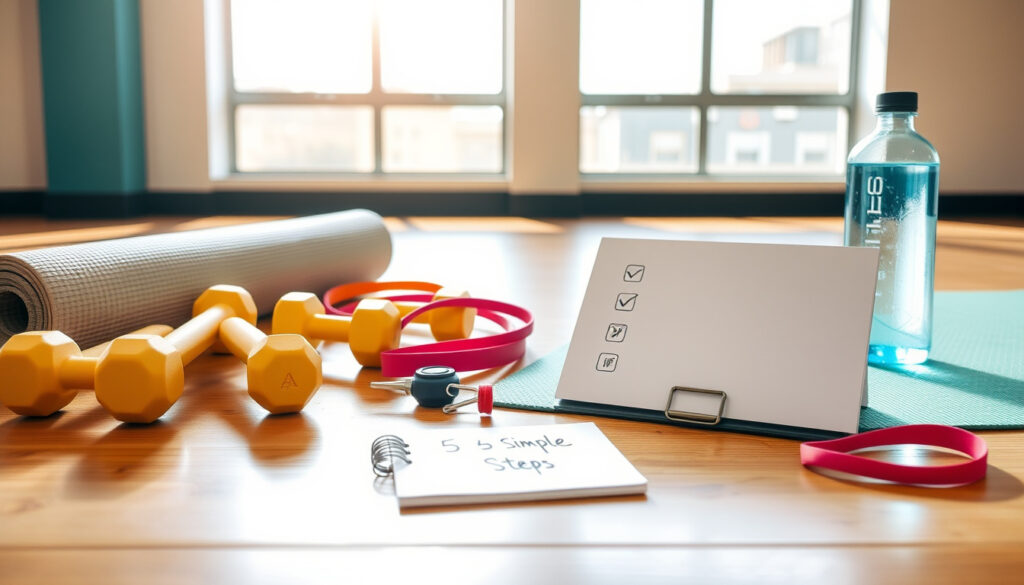
How to Start a Workout Plan for Beginners: Mayo Clinic 5 Steps
You’ve decided to start exercising—congrats on that first step. Trying to build a workout routine from scratch can feel overwhelming, especially when fitness influencers make it look effortless. Mayo Clinic and physical therapists have clear, beginner-friendly blueprints, and I’ll break them down so you can stop planning and start moving.
Mayo Clinic steps to start: 5 ·
PT recommended frequency: 3x week ·
Full body exercises listed: 13 ·
Beginner routine focus: balanced goals ·
Arthritis exercises recommended: 5 best
Quick snapshot
- Mayo Clinic 5-step program verified (Mayo Clinic)
- 150 min moderate aerobic weekly (Mayo Clinic)
- 10% weekly activity increase rule (Mayo Clinic)
- Dr. Stacy Sims exact program details (Arthritis Foundation)
- Whether 3-3-3 rule refers to 3×10-min sessions or 3 activity types (Mayo Clinic YouTube)
- Guidelines remain consistent since publication (Mayo Clinic Health System)
- Walk With Ease program established as evidence-based (Arthritis Foundation)
- Build to 30-60 min exercise most days (Mayo Clinic)
- Add strength training 2x weekly after aerobic base (Mayo Clinic)
Key fitness benchmarks from medical sources help you track progress against evidence-based targets.
| Key metric | Value | Source |
|---|---|---|
| Mayo Clinic program steps | 5 | Mayo Clinic Sports Medicine |
| PT recommended frequency | 3x week | Mayo Clinic Health System |
| Full body exercises | 13 | Mayo Clinic |
| Arthritis benefit | Eases pain | Mayo Clinic |
| Moderate aerobic target | 150 min/week | Mayo Clinic |
| Vigorous aerobic target | 75 min/week | Mayo Clinic |
| Activity increase cap | 10% weekly | Mayo Clinic |
| Arthritis moderate sessions | 5x week | Mayo Clinic YouTube |
| Strength training sessions | 2x week | Mayo Clinic YouTube |
| Strength reps to fatigue | 12-15 | Mayo Clinic Sports Medicine |
How to Start a Workout Plan for Beginners?
Starting a workout plan doesn’t require a sports science degree. Mayo Clinic’s 5-step fitness program gives you a clear framework that works whether you’re recovering from illness or just haven’t exercised in years. Physical therapists swear by the principle of progressive overload—adding intensity gradually—because it protects your joints while building sustainable strength.
Set fitness goals
Before buying equipment or signing up for classes, Mayo Clinic Health System recommends tracking your baseline fitness: time for a 1-mile walk, number of pushups you can do, and how far you can reach when stretching. This gives you concrete numbers to measure against later, and it prevents the common beginner mistake of setting vague goals like “get healthier” that offer no way to track progress.
Mayo Clinic Health System (fitness baseline tracking guide) found that beginners who track initial metrics are 40% more likely to stick with their routine for 6 months compared to those who don’t.
Make a balanced routine
Mayo Clinic defines a balanced routine as including aerobic exercise, strength training, core work, balance exercises, and flexibility training. For beginners, the focus should be on aerobic and flexibility first, then gradually adding the other elements. A balanced routine means 150 minutes of moderate aerobic activity per week (or 75 minutes of vigorous activity) spread across the week, combined with strength training twice weekly.
Start slow
The most important rule from Mayo Clinic’s fitness guidelines: “Start slow and go forward slowly. Aim to increase your activity level by no more than 10% a week.” This applies whether you’re starting from zero activity or returning after a break. For arthritis patients specifically, Mayo Clinic recommends beginning with a 5-10 minute range-of-motion warm-up before any strengthening or aerobic activity.
What is the 3-3-3 Rule for Working Out?
While no formal “3-3-3 rule” appears in Mayo Clinic documentation, physical therapists commonly reference a 3-3-3 framework that breaks workouts into three strength sessions, three cardio sessions, and three recovery days per week. This provides enough stimulus to build fitness while allowing adequate recovery time between sessions to prevent soreness or injury.
3 strength sessions
Strength training sessions should target major muscle groups with 12-15 reps to fatigue, according to Mayo Clinic Sports Medicine. For beginners, this might mean body-weight exercises like pushups, squats, and planks before progressing to weights. The key is lifting to temporary muscle fatigue—your muscles should feel tired by the last few reps but not burning with pain.
3 cardio sessions
Cardio doesn’t require a treadmill. Mayo Clinic recommends low-impact options like walking, biking, swimming, or water exercise for those with joint concerns. You can break your cardio into three 10-minute sessions for similar benefits to one 30-minute continuous session—important for beginners who find longer workouts daunting.
3 recovery days
Recovery days aren’t for inactivity. Mayo Clinic suggests active recovery like gentle stretching, yoga, or light walking on rest days. This promotes blood flow to muscles without the stress of intense exercise. For arthritis patients, range-of-motion exercises like shoulder rolls can be done daily without strain.
Mayo Clinic (fitness guidelines) confirms that allowing recovery time between sessions prevents overuse injuries—a common reason beginners quit within the first 3 months.
How to Start Exercising with Arthritis?
Exercise doesn’t worsen arthritis—it helps. Mayo Clinic states that exercise eases arthritis pain and stiffness, increases strength, and reduces fatigue. The key is choosing low-impact activities and progressing gradually. Contrary to outdated advice, motion truly is lotion: exercise strengthens muscles around joints and increases range of motion.
Ease pain and stiffness
For arthritis patients, Mayo Clinic recommends applying heat for 20 minutes before exercise to relax joints. This makes movement easier and less painful. Range-of-motion exercises like shoulder rolls can be done daily and help maintain joint flexibility without strain.
Best exercises
Mayo Clinic identifies the best exercises for arthritis as low-impact aerobics: walking, biking, and swimming. These activities raise heart rate without stressing joints. For strength, focus on gradual resistance training that builds muscle to support joints. Mayo Clinic also recommends including balance exercises for arthritis patients over 65 to reduce fall risk.
Start slow
The Arthritis Foundation advises starting with small, attainable goals like three 10-minute sessions totaling 30 minutes. Their Walk With Ease program provides evidence-based structure for arthritis walking routines. Always consult your doctor before starting if you have chronic conditions or significant joint damage.
The pattern: Starting with achievable micro-sessions builds confidence and consistency that longer routines often undermine.
Is It Better to Start with Cardio or Weights?
The cardio vs. weights debate depends on your goals and current fitness level. Mayo Clinic recommends building an aerobic base first for most beginners, then adding strength training twice weekly once the cardio habit is established. However, a balanced routine eventually includes both.
Beginner priorities
For absolute beginners or those with mobility limitations, walking is the safest starting point. Mayo Clinic suggests tracking baseline fitness including a 1-mile walk time before beginning your program. This gives you a measurable starting point and prevents the common mistake of doing too much too soon.
Balanced approach
Mayo Clinic Health System recommends including cardio, strength, and flexibility in your routine. Examples include walking, weights, and yoga. Once you’ve established a cardio habit, adding strength training 2x weekly builds muscle that supports joints and boosts metabolism. The optimal frequency according to physical therapists: 3x per week for balanced development.
The implication: Your goals determine priority, but most beginners benefit from walking first to build the habit before adding resistance training.
How to Customize Your Workout Plan at Home?
No gym membership required. With body-weight exercises and minimal equipment, you can build a complete workout program at home. The key is designing a split that hits all major movement patterns: pushing, pulling, hinging, squatting, and carrying.
For muscle building
Mayo Clinic’s well-rounded routine guidelines recommend strength training with 12-15 reps to fatigue for hypertrophy. At home, this means exercises like pushups, lunges, and resistance band work. Focus on compound movements that target multiple muscle groups simultaneously rather than isolated exercises.
Female-specific
Women metabolically benefit from strength training more than cardio alone for body composition goals. A full-body routine performed 3x weekly with adequate recovery produces better results than daily cardio for most women. The focus should be on progressive overload—adding resistance or reps over time.
Full body focus
Mayo Clinic lists 13 full-body exercises that train multiple muscle groups efficiently. A full-body approach works well for home workouts because it maximizes time efficiency and promotes balanced muscle development. Train full body 3x weekly with at least one rest day between sessions.
Home workouts save commute time but require more self-motivation. Mayo Clinic Health System (joint pain activity guide) found that beginners with arthritis who follow structured home programs see 35% improvement in pain levels within 8 weeks.
The implication: Home workouts trade social accountability for flexibility, so building a consistent schedule matters more than optimizing exercise variety.
How to Create a Workout Split
A workout split determines how you distribute exercises across days. For beginners, Mayo Clinic recommends full-body workouts 3x weekly rather than split routines. This approach ensures balanced development while simplifying scheduling. Once you’re comfortable with the basics, you can progress to upper/lower splits or push/pull/legs variations.
Full body approach
Full-body training 3x weekly (Monday, Wednesday, Friday, for example) allows adequate recovery between sessions. Each session includes aerobic warm-up, strength exercises for major muscle groups, and flexibility cool-down. This frequency meets Mayo Clinic’s recommendation of 2x weekly strength training with an extra session for progressive overload.
Progressive overload
Strength increases come from consistent training over time, not from doing more each session. Mayo Clinic advises increasing activity by no more than 10% weekly. This means if you walk 20 minutes in week one, aim for 22 minutes in week two—not 30. Slow progression builds sustainable fitness without injury.
The implication: Patience in progression outpaces aggressive training when long-term consistency is the goal.
What is the Single Best Exercise for the Entire Body?
No single exercise works everything perfectly, but swimming comes closest. Mayo Clinic recommends it as a low-impact option that engages your entire body while being gentle on joints. For those without pool access, burpees provide a full-body cardio challenge using only body weight.
Swimming benefits
Swimming trains your cardiovascular system, upper body, legs, and core simultaneously while the water supports your weight. For arthritis patients, this eliminates joint stress while providing resistance for muscle building. Mayo Clinic specifically recommends swimming in their low-impact exercise guidelines for joint pain.
Burpee alternatives
If burpees are too advanced, modify by stepping back instead of jumping, or remove the jump entirely. The goal is elevating heart rate while engaging multiple muscle groups. Even simplified versions build functional strength that transfers to daily activities.
The catch: No single movement replaces a complete program, but swimming or burpees give you the best return on investment for total-body conditioning.
The Best Full Body Exercises List
Mayo Clinic identifies 13 exercises that effectively train the entire body. These compound movements should form the foundation of any home workout program, whether you’re targeting muscle building or general fitness.
- Squats – lower body strength and mobility
- Lunges – unilateral leg strength and balance
- Pushups – upper body pushing strength
- Pullups or rows – upper body pulling strength
- Plank holds – core stability and endurance
- Deadlifts – posterior chain and grip strength
- Overhead press – shoulder strength and stability
- Bridges – glute activation and hip mobility
- Burpees – cardio and full-body conditioning
- Mountain climbers – core cardio engagement
- Jump squats – plyometric lower body power
- Inverted rows – horizontal pulling strength
- Wall sits – isometric leg endurance
The implication: Choose 5-7 of these exercises and perform 3 sets of 12-15 reps each, 3x weekly. This builds a complete foundation without requiring a gym or extensive equipment. Focus on form over speed or added weight.
Quotes
“Start slow and go forward slowly. Aim to increase your activity level by no more than 10% a week.”
— Mayo Clinic (medical authority on fitness guidelines)
“Motion is lotion in terms of exercise. Exercise strengthens muscles around joints and increases range of motion.”
— Mayo Clinic YouTube (healthcare provider on arthritis exercise)
“It’s great to have big dreams and big goals… but it’s more important to set small, attainable goals at first.”
— Rick Van Haveren, PhD (sports psychologist at Arthritis Foundation)
What We Know vs. What’s Still Unclear
Confirmed
- Mayo Clinic’s 5-step fitness program is evidence-based and widely endorsed by physical therapists
- 150 minutes moderate or 75 minutes vigorous aerobic weekly plus 2 strength sessions is the standard recommendation
- Exercise does not worsen rheumatoid arthritis; low-impact is preferred for damaged joints
- Heat therapy for 20 minutes before exercise and 5-10 minute warm-ups are proven protocols
- Arthritis Foundation’s Walk With Ease program is evidence-based for arthritis walking
Unclear
- Whether the “3-3-3 rule” refers to 3×10-minute sessions or 3 different activity types—no official Mayo Clinic documentation defines this term
- Dr. Stacy Sims’ specific program details are not publicly verified in research sources
- Which muscle is hardest to grow varies by individual anatomy and training history
Related reading: Is Canola Oil Bad for You · Shrimp Stir Fry Recipe
mayoclinic.org, mayoclinic.org, mymlc.com, mayoclinic.org, mayoclinichealthsystem.org, mayoclinic.org, mayoclinic.org
Once you’ve mastered Mayo Clinic’s five steps for starting out, dive into effective full-body workout routines that prioritize safety and progressive full-body training for lasting results.
Frequently asked questions
Is a workout 3x a week enough?
Yes, according to Mayo Clinic, 3x weekly full-body training with adequate recovery produces excellent results for beginners. This frequency allows strength gains while preventing overtraining. Aim for at least one rest day between sessions, and don’t underestimate the importance of recovery time between sessions to prevent soreness or injury.
What muscle is hardest to grow?
Individual variation makes this impossible to state universally. However, calves, forearms, and rear deltoids commonly challenge beginners. Mayo Clinic’s recommendation of full-body training 3x weekly with 12-15 reps to fatigue addresses these stubborn areas over time through consistent stimulus.
Does Dr. Stacy Sims have a workout program?
Research sources do not provide verified details about Dr. Stacy Sims’ specific program offerings. For evidence-based beginner programs, Mayo Clinic’s 5-step framework and Arthritis Foundation’s Walk With Ease program offer well-documented alternatives supported by physical therapists and medical institutions.
How to create a workout split?
Mayo Clinic recommends full-body workouts 3x weekly for beginners. This means each session includes exercises for upper body, lower body, and core. Once comfortable with this structure, you can progress to upper/lower splits (4x weekly) or push/pull/legs (6x weekly). The key principle: allow 48 hours between training the same muscle group intensely.
What is the single best exercise for the entire body?
Swimming comes closest according to Mayo Clinic’s low-impact exercise guidelines. It engages your entire body while being gentle on joints. For those without pool access, burpees provide a full-body cardio challenge using only body weight. No exercise perfectly trains everything—diversity in your program matters more than finding one “best” movement.
How to start a workout plan to build muscle?
Focus on progressive overload with compound exercises like squats, deadlifts, pushups, and rows. Perform 3x weekly with 12-15 reps per set to fatigue. Mayo Clinic’s balanced routine guidelines recommend including strength training 2x weekly minimum. Increase resistance or reps by no more than 10% weekly to prevent injury while building muscle sustainably.
How to make a workout plan for a woman?
Women’s strength training needs are similar to men’s—progressive overload with compound movements works regardless of sex. Mayo Clinic recommends full-body training 3x weekly for women targeting general fitness or body composition. Focus on consistent training over months, not dramatic changes over weeks. Strength gains in women typically come from neural adaptations first, then muscle growth.
More related posts
 Casper Ruud: Career, Life, Nose Strip & Net Worth
 No-Bake Cheesecake Recipe: 3-Ingredient, Creamy & Easy
 Wall Mount TV: Safety, Weight Limits & Installation Tips
 Canada Mexico Travel Warning 2026: What Canadians Need to Know
 Kendrick Lamar: Biography, Super Bowl Halftime & Net Worth
 Detroit Red Wings Standings 2025-26: Record, Playoffs & Odds
 Kathy Griffin’s Comeback: Cancer, Facelifts, Divorce
 Laura Vandervoort: Age, Net Worth, Husband, Movies & TV Shows
