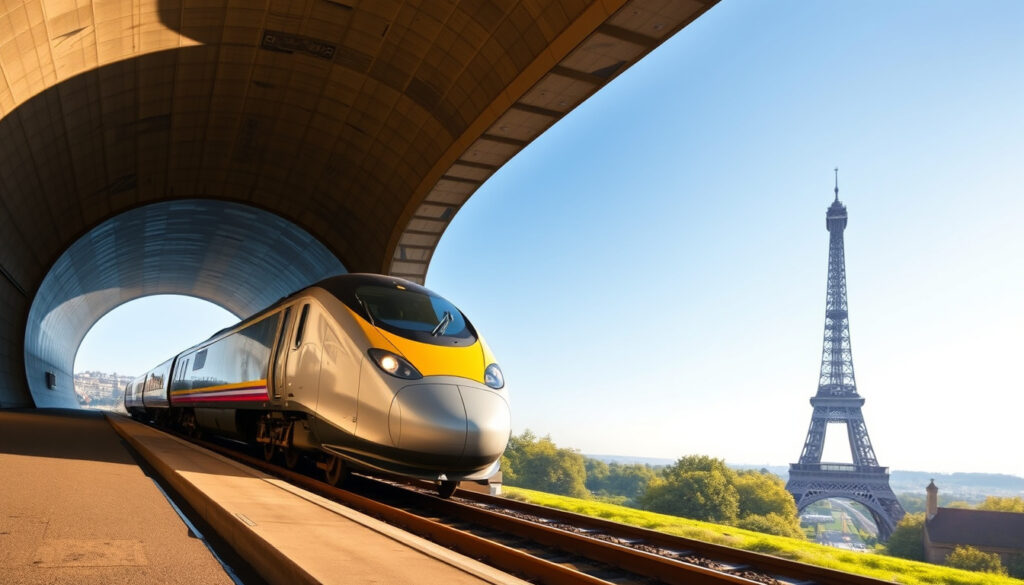
Eurostar London to Paris – Train Times, Tickets & Guide
Eurostar high-speed trains connect London and Paris with a direct service that has become one of the most popular cross-channel travel options. The route crosses the English Channel through the famous Channel Tunnel, offering passengers a seamless journey between the two capital cities without the hassle of airport security or flying.
The service operates from London St Pancras International to Paris Gare du Nord, covering approximately 492 kilometres in as little as two hours and sixteen minutes. This makes train travel a competitive alternative to flying, particularly for travellers who value central-to-central connections and the ability to avoid congested airports.
This guide covers everything you need to know about the Eurostar London to Paris route, from journey times and ticket options to what to expect when passing through the Channel Tunnel.
How long does the Eurostar from London to Paris take?
Key Insights for Eurostar London to Paris
- The fastest London to Paris journey takes just 2 hours and 16 minutes on the most direct services
- The total route distance is approximately 492 kilometres, including the Channel Tunnel section
- The Channel Tunnel itself spans 50.45 kilometres, with 23.5 miles running beneath the sea floor
- Trains reach speeds of up to 186 mph on land sections and 100 mph while underground
- Passengers should arrive at least 90 minutes before departure for check-in and security procedures
- The tunnel descent reaches 75 metres below sea level at its deepest point
- Eurostar is passenger-only; vehicles must use the separate Eurotunnel Le Shuttle service
Eurostar London to Paris Facts at a Glance
| Aspect | Details |
|---|---|
| Fastest Journey Time | 2h 16m |
| Typical Range | 2h 16m to 2h 37m |
| Total Distance | ~492 km (305 miles) |
| Tunnel Underwater Length | 23.5 miles (37.9 km) |
| Tunnel Travel Time | Approximately 35 minutes |
| Maximum Land Speed | 186 mph (300 km/h) |
| Maximum Tunnel Speed | 100 mph (160 km/h) |
| Maximum Depth | 75 metres below sea level |
| Departure Station | London St Pancras International |
| Arrival Station | Paris Gare du Nord |
| Tunnel Endpoint (UK) | Folkestone |
| Tunnel Endpoint (France) | Calais |
Where to book Eurostar London to Paris tickets?
Official Eurostar Website
The most reliable source for booking Eurostar tickets is the official Eurostar website. The platform allows passengers to search schedules, compare prices across different fare types, and select their preferred travel class. The website provides real-time availability and often features promotional fares for advance bookings.
For those planning specific travel dates, the official timetable page displays current schedules for the London St Pancras to Paris Gare du Nord route. Timetables can vary seasonally and during special events, so checking close to your intended travel date remains advisable.
Round Trip and Return Options
Flexible return tickets are available for passengers travelling on different dates. One-way fares are also offered, though round-trip bookings can sometimes represent better value depending on the travel period. Early booking typically unlocks the lowest available fares, with prices starting from approximately €44 for Standard class seats.
Passengers should be aware that prices fluctuate based on demand, time of day, and how far in advance tickets are purchased. Signing up for fare alerts through the official website can help identify the most economical booking windows.
Prices tend to be lowest when booking several weeks ahead of travel. Flexible tickets allow date changes without fees, though standard discounted fares may carry restrictions.
Does the Eurostar go underwater from London to Paris?
The Channel Tunnel Explained
Yes, the Eurostar route includes a substantial underwater section. The Channel Tunnel, often called the “Chunnel,” is the world’s longest undersea rail tunnel, stretching 50.45 kilometres in total length. Of this, 37.9 kilometres runs beneath the English Channel seabed, making it one of the most significant engineering achievements in modern railway history.
The tunnel connects Folkestone in the United Kingdom with Calais in northern France. Passengers experience approximately 35 minutes of underground travel, during which the train descends to a maximum depth of 75 metres below sea level. Unlike some other underwater tunnels, there are no viewing windows—the interior remains pitch black throughout the submarine section.
The Channel Tunnel crossing takes about 35 minutes in complete darkness. Train speed reduces to 100 mph for safety during this section, compared to 186 mph on open tracks.
Tunnel Construction and Route
Construction of the Channel Tunnel began in 1988 and the tunnel opened for rail services in 1994. Three separate tunnels were built: two for rail traffic and one service tunnel for maintenance access. The tunnel reaches its lowest point 246 feet beneath the sea surface, with the rail lines positioned within the chalk strata beneath the Channel floor.
The Eurostar service runs non-stop through the tunnel without pausing at any intermediate point. Passengers simply notice the gradual descent, darkness, and subsequent ascent as the train transitions between British and French rail networks.
What are the Eurostar London to Paris travel options?
Travel Classes Available
Eurostar offers three distinct travel classes to accommodate different passenger preferences and budgets. Standard class provides essential amenities and comfortable seating for the two-hour journey. Standard Premier, or Plus, offers upgraded seating with additional legroom, power outlets at each seat, and complimentary light meals or refreshments depending on the route.
Premier class represents the highest level of service, featuring spacious seats, gourmet dining options, and access to dedicated station lounges in both London and Paris. Business class travellers particularly appreciate the extra luggage allowance and expedited boarding options available with premium tickets.
Can you take a car on Eurostar?
Eurostar does not transport vehicles. The service is passenger-only, meaning travellers cannot bring cars, motorcycles, or other vehicles aboard the train. Those requiring vehicle transport across the Channel must use the separate Eurotunnel Le Shuttle service, which operates from Folkestone to Calais with a crossing time of approximately 35 minutes.
Eurostar carries passengers only. For car transport between the UK and France, the Eurotunnel Le Shuttle from Folkestone to Calais offers the alternative channel crossing option.
Luggage and Amenities
All Eurostar passengers can bring two pieces of luggage plus hand luggage aboard the train. Business and Premier class passengers receive additional luggage allowances. Each carriage features accessible toilets and refreshment services, with Standard class passengers able to purchase food and drinks from the onboard café-bar.
Eurostar London to Paris Journey Timeline
Understanding the sequence of events during the journey helps passengers prepare for what lies ahead. The following timeline outlines key milestones from departure to arrival.
- Check-in and Security — Passengers must complete security and passport checks at London St Pancras, arriving at least 90 minutes before departure
- Boarding — Boarding begins approximately 20-30 minutes before departure, with gates closing ahead of schedule
- Departure from St Pancras — The train departs London St Pancras International, accelerating through the Thames Valley and Kent countryside
- Entering the Channel Tunnel — After approximately 60 minutes of surface travel, the train enters the tunnel at Folkestone
- Underwater Crossing — The train travels through complete darkness for approximately 35 minutes at reduced speed
- Exiting in France — The train emerges from the tunnel near Calais, entering the French rail network
- Northern France Scenery — Passengers can view the French countryside before the route becomes more urban
- Arrival at Gare du Nord — The train pulls into Paris Gare du Nord, completing the 492-kilometre journey
Confirmed Facts vs Variables
When planning Eurostar travel, it helps to distinguish between information that remains constant and details that can change. The table below separates established facts from aspects that may vary.
| Established Information | Variable Information |
|---|---|
| Non-stop route from St Pancras to Gare du Nord | Exact ticket prices (change with demand) |
| Fastest journey time of 2h 16m | Timetable frequencies (vary by season) |
| Channel Tunnel crossing of approximately 35 minutes | Availability of specific departure times |
| Maximum speed of 186 mph on land sections | Promotional fares and special offers |
| Maximum tunnel speed of 100 mph | Onboard catering menus and offerings |
| Total distance of approximately 492 km | Minimum check-in requirements (may change) |
| Three travel classes available | Lounge access eligibility criteria |
| Vehicle transport not available on Eurostar | Currency exchange rates affecting pricing |
Why Choose Eurostar London to Paris?
The Eurostar service offers several compelling advantages over alternative transport methods. Perhaps most significantly, both terminus stations sit in city centres, eliminating the need for additional airport transfers that flying would require. A journey from central London to central Paris takes roughly the same door-to-door time as the equivalent flight when accounting for airport check-in, security, and baggage claim.
Environmental considerations also favour rail travel. High-speed trains produce significantly lower carbon emissions per passenger kilometre than aircraft, making the Eurostar a more sustainable choice for environmentally conscious travellers. The ability to work, read, or simply watch the scenery pass by also makes the journey more productive than the confined environment of an aircraft cabin.
For international travellers, the passport control process at St Pancras before departure means arrival in France involves minimal additional formalities. This streamlined approach appeals particularly to regular business travellers and tourists seeking maximum efficiency during their visit.
Official Sources and Further Information
Eurostar operates direct services from London St Pancras International to Paris Gare du Nord, with the route crossing the Channel Tunnel connecting Folkestone and Calais. The service offers three comfort classes and operates multiple daily departures to accommodate different travel schedules.
— Eurostar official travel information
Before booking, passengers should verify their travel documentation requirements. UK citizens travelling to France should check whether a visa or ETIAS authorisation will be required, as entry requirements may change following Brexit and upcoming European travel regulation updates.
For those seeking the most current schedules and pricing, the official Eurostar London to Paris page remains the authoritative source. Third-party aggregators such as TheTrainLine also compile comparisons across operators, though direct booking through Eurostar often provides the clearest access to flexible tickets and customer support.
Next Steps for Your London to Paris Journey
Planning your Eurostar trip involves several straightforward steps. First, verify your travel documentation is in order and check whether you need any additional permits for entry into France or the Schengen Area. Next, decide on your travel dates and class preference, keeping in mind that weekday departures outside peak hours often offer better value.
Once ready to book, compare fares across the official website and authorised resellers, paying attention to ticket flexibility terms. Remember to arrive at St Pancras at least 90 minutes before departure to allow sufficient time for security and passport checks. Pack appropriately for a two-hour journey with access to refreshments aboard the train.
For those comparing travel options for upcoming events, the Olympique de Marseille vs PSG stats and Benfica vs Chelsea FC lineups provide examples of how Eurostar travel enables attendance at major European sporting fixtures.
Frequently Asked Questions
How long is the Channel Tunnel crossing on Eurostar?
The Channel Tunnel crossing takes approximately 35 minutes. During this time, the train travels at 100 mph through complete darkness before emerging near Calais in France.
Can I bring my car on Eurostar?
No. Eurostar is a passenger-only service. Vehicles must use the separate Eurotunnel Le Shuttle service, which operates ferries from Folkestone to Calais.
How much time should I allow for Eurostar check-in?
Passengers should arrive at London St Pancras at least 90 minutes before their scheduled departure time to complete security and passport checks.
What are the Eurostar travel classes?
Eurostar offers Standard class, Standard Plus/Premier with upgraded seating and meals, and Premier class with full business amenities and lounge access.
Is Eurostar faster than flying London to Paris?
Actual flight time is shorter, but when accounting for airport transfers, security, and baggage handling, door-to-door travel times are often comparable between Eurostar and flights.
How far in advance should I book Eurostar tickets?
Tickets are generally cheapest when booked several weeks ahead. Last-minute availability is limited, particularly during peak travel periods and holidays.
What is the fastest Eurostar journey time London to Paris?
The fastest scheduled journey takes 2 hours and 16 minutes on the most direct services. Most trains complete the journey in under 2 hours 40 minutes.
Does Eurostar go underwater?
Yes. The route includes passage through the Channel Tunnel, an underwater rail tunnel running 37.9 kilometres beneath the English Channel seabed.
More related posts
 Samsung S25 Ultra Price Ireland: Deals, Specs & Worth It?
 Robbie Coltrane: Cause of Death, Estate, and Co-Star Reactions
 After Movies in Order: Full Guide to Watch 2019-2023 Series
 Shrimp Stir Fry Recipe – Quick 30-Min Dinner with Crisp Veggies
 Lil Peep’s Death: Diagnosis, Last Words, and Musical Legacy
 Chet Holmgren: Height, Injury, Salary & NBA Career
 How to Play Poker: Rules, Hands, and Strategy for Beginners
 How to Make Slow Cooker Beef Stew: Tips and Recipe
