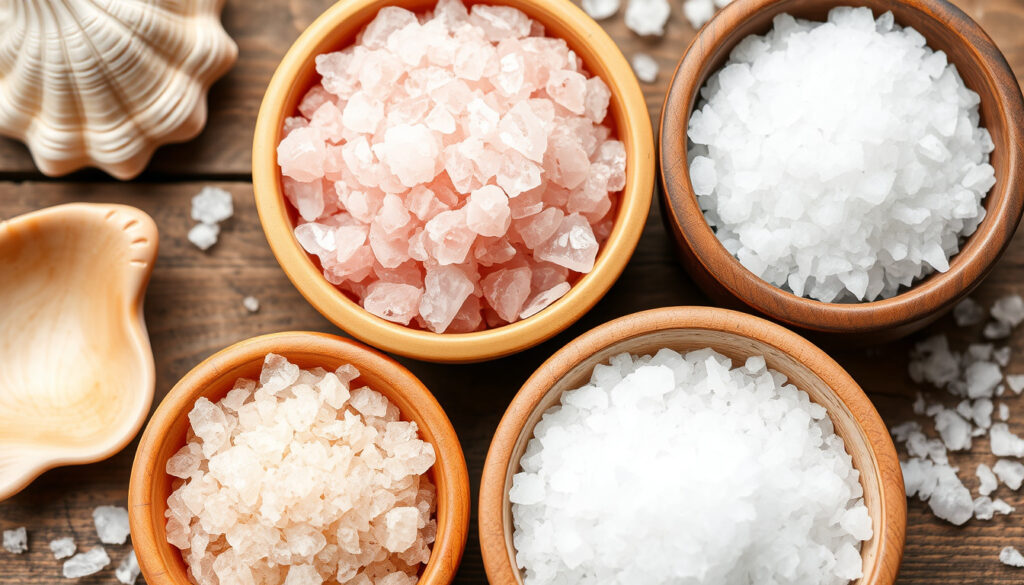
Sea Salts: Benefits, Types, and Which Is Healthiest
Few pantry staples spark as much curiosity as sea salt. Most of us know it’s less processed than table salt, but the real question is whether the extra minerals actually make a difference. Celtic sea salt, for instance, gets its gray hue from higher concentrations of magnesium and calcium, according to WebMD. Yet the University of Warwick fact-check on salt claims finds that the nutritional gap between sea salt and table salt is virtually zero.
Trace minerals in Celtic sea salt: magnesium, calcium, potassium ·
Sodium per teaspoon of sea salt: 2,300 mg ·
Number of sea salt types: 4 main types
Quick snapshot
- Sea salt is produced by evaporating seawater (Healthline)
- Celtic sea salt gets its gray color from magnesium, calcium, potassium, zinc, and iron (WebMD)
- Sea salt provides only 0.08% of the dietary reference intake for minerals when 5 g is consumed (University of Warwick)
- Which sea salt is the absolute healthiest — no consensus among dietitians (WebMD)
- Microplastic contamination levels in commercial sea salt brands remain under investigation (WebMD)
- Whether the mineral difference between Celtic salt and table salt has any clinical benefit (WebMD notes no proven advantage)
- 2024: University of Warwick publishes fact-check highlighting negligible nutritional difference between sea salt and table salt (University of Warwick)
- Consumer demand for transparency in mineral content and harvesting methods is increasing, especially for artisanal Irish sea salts
| Attribute | Value |
|---|---|
| Production method | Evaporation of seawater |
| Primary minerals | Sodium, chloride, magnesium, calcium, potassium |
| Celtic sea salt origin | Brittany, France |
| Irish sea salt source | Keel Bay, Achill Island |
| World’s most popular sea salt type | Celtic (Sel Marin) and Fleur de Sel |
What are sea salts good for?
Culinary uses
- Sea salt is the primary seasoning in kitchens worldwide, valued for its flaky texture and burst of pure salinity. Healthline notes that it is less refined than table salt, retaining trace minerals that can affect flavor.
- Chefs often use coarse sea salt as a finishing salt — think Fleur de Sel on caramel or a grilled steak.
Cosmetic and skin care
- Sea salt is a common ingredient in body scrubs and bath soaks, where its mineral content — magnesium, calcium, potassium — is said to soothe muscles and exfoliate skin. The Food Network reports that sea salts contain more trace minerals than refined table and kosher salts.
Food preservation
- For centuries, sea salt has been used to cure meats, fish, and vegetables. The high sodium content draws out moisture, inhibiting bacterial growth.
The implication: You pay for taste and texture, not for a nutritional edge.
Which sea salt is healthiest?
Celtic sea salt vs Himalayan pink salt
- Celtic sea salt, hand-harvested from the coastal ponds of Brittany, contains 2 mg potassium, 5 mg magnesium, 3 mg calcium, and 468 mg sodium per 1/4 teaspoon (1.5 g), according to Food Network.
- Himalayan pink salt, mined from ancient sea beds in Pakistan, is often touted for its iron content (which gives it the pink color). However, University of Warwick researchers emphasize that the mineral amounts in any sea salt are negligible — just 0.08% of daily intake when consuming the maximum recommended 5 g of salt.
Irish Atlantic sea salt profile
- Irish sea salt brands like Achill Island Sea Salt are hand-harvested from the wild Atlantic waters of Keel Bay. The brand describes its product as “award winning pure and natural Irish Sea Salt.” While the mineral profile is similar to Celtic salt, the unique selling point is the pristine source and traditional harvesting method, not a dramatically different nutritional composition.
If you are looking for a slight mineral edge, Celtic salt edges out table salt. But WebMD states there are “no specific benefits to using Celtic salt over any other type of salt.” The healthiest choice may simply be the one you use least.
The catch: Sea salt’s health halo is mostly marketing — the real benefit is culinary, not clinical.
What is Irish sea salt?
Achill Island Sea Salt production
- Harvested by hand from Keel Bay on Achill Island, this salt is dried naturally by the Atlantic wind and sun. The brand’s own description — “award winning pure and natural Irish Sea Salt, hand harvested from the wild Atlantic waters of Keel Bay” — reflects its artisanal positioning.
West of Dingle Sea Salt
- Another small-batch producer, West of Dingle Sea Salt, sources from the pristine waters off the Dingle Peninsula. Both brands emphasize minimal processing and traceability over mass production.
Dublin Spice Company Celtic sea salt
- Dublin Spice Company offers a Celtic sea salt sourced from Brittany, France, rather than Ireland. This highlights that “Celtic sea salt” is a geographical indication tied to the region’s traditional methods, not a generic Irish label.
The implication: Irish sea salt is a niche, premium product. Its value lies in the story and the terroir, not a measurable nutritional advantage over other unrefined sea salts.
Which is better, Himalayan or Celtic sea salt?
Mineral content comparison
One pattern emerges from the data: both are superior to table salt in trace mineral content, but the differences between them are minor.
| Mineral per 1/4 tsp (1.5 g) | Celtic (gray) | Himalayan (pink) |
|---|---|---|
| Potassium | 2 mg | ~1 mg |
| Magnesium | 5 mg | ~1.5 mg |
| Calcium | 3 mg | ~1 mg |
| Iron | trace | ~0.3 mg |
| Sodium | 468 mg | ~460 mg |
Data for Celtic from Food Network; Himalayan values from Healthline.
Taste and texture differences
- Celtic sea salt is moist and coarse, with a briny, mineral-forward flavor. Himalayan salt is drier and less bold, making it a better all-purpose cooking salt.
Cost and availability
- Celtic salt is widely available in health food stores and online (e.g., Organico). Himalayan salt is cheaper and sold in most supermarkets. Irish sea salt sits at the premium end, with limited distribution.
The catch: your choice matters more for texture and price than for health. As WebMD puts it, no specific health benefits distinguish one from the other.
What are the disadvantages of sea salt?
High sodium content
- Sea salt is about 40% sodium by weight — virtually identical to table salt. A teaspoon of fine sea salt contains roughly 2,300 mg of sodium, the entire daily limit recommended by the American Heart Association. Healthline warns that overconsumption raises blood pressure.
Potential contamination with microplastics
- Recent studies have detected microplastics in sea salt samples worldwide. The extent of contamination varies by brand and source, but it is a growing concern for consumers seeking a “natural” product. Southern Pulse notes that this issue is not yet fully quantified.
Iodine deficiency risk
- Sea salt does not usually contain added iodine, unlike iodized table salt. National Nutrition states that the natural iodine content in sea salt is insufficient to prevent deficiency, making it a poor choice for those relying on salt alone for iodine.
If you switch exclusively to sea salt and do not eat iodine-rich foods like fish or dairy, you risk iodine deficiency. The University of Warwick fact-check reinforces that the mineral content of sea salt is negligible — so the only real downside is the same as any salt: too much sodium.
The pattern: Sea salt’s disadvantages mirror table salt’s — the main risk is overconsumption, not mineral quality.
What are the 4 types of salts?
Four types of salt, one pattern: processing level determines mineral retention, but sodium dominates every gram.
| Type | Processing | Mineral content | Best use |
|---|---|---|---|
| Table salt | Highly refined, anti-caking agents added | 99.9% sodium chloride | General cooking, baking |
| Sea salt | Minimally processed, evaporation | Trace minerals (Mg, Ca, K) | Seasoning, finishing |
| Himalayan pink salt | Mined, minimal processing | Trace minerals, including iron | Cooking, salt grinders |
| Celtic sea salt | Hand-harvested, unrefined | Higher Mg, Ca, K than refined | Finishing, gourmet dishes |
The implication: Choose salt by how you cook, not by what you read on a label — sodium content is nearly identical across all types.
Beyond the kitchen, each salt has a distinct chemical signature that affects how it behaves in recipes.
| Specification | Table salt | Sea salt | Himalayan | Celtic |
|---|---|---|---|---|
| Crystal size | Fine, uniform | Irregular, coarse to fine | Fine to medium | Coarse, moist |
| Color | White | White, gray, or pink | Pink to red | Gray |
| Moisture content | Very low | Low | Low | Relatively high |
| Iodine added? | Usually yes | No | No | No |
| Price per 100g (approx.) | $0.10 | $0.50–$2.00 | $0.40–$1.50 | $1.00–$3.00 |
The catch: Price reflects harvesting labor, not nutritional superiority — so save money unless texture matters.
Upsides
- Less processed than table salt, retaining natural mineral profile
- Variety of textures and flavors for culinary creativity
- Artisanal sea salts support small-scale producers and traditional methods
- No anti-caking agents or additives in unrefined types
Downsides
- Same sodium content as table salt — overconsumption still a health risk
- No added iodine, which can lead to deficiency if not supplemented through diet
- Microplastic contamination is a potential concern in some brands
- Higher cost with no proven clinical benefit over cheaper alternatives
What we know for sure — and what remains uncertain
Confirmed facts
- Sea salt is produced by evaporating seawater (Healthline)
- Celtic sea salt contains more magnesium, calcium, and potassium than refined table salt (WebMD)
- University of Warwick confirms that the mineral contribution of sea salt is negligible at recommended intake levels (University of Warwick)
- Irish sea salt is hand-harvested from the Atlantic, with brands like Achill Island and West of Dingle (brand statements)
What’s unclear
- Whether the slight mineral differences have any measurable health impact
- Microplastic contamination levels across different brands and regions
- Which sea salt is “best” — the answer depends on taste, price, and cooking application, not nutrition
Expert perspectives on sea salt
“Award winning pure and natural Irish Sea Salt, hand harvested from the wild Atlantic waters of Keel Bay.”
— Achill Island Sea Salt brand
“Celtic salt contains higher content of trace minerals like magnesium, calcium and potassium compared to normal salt.”
— Holland & Barrett editorial team
“There do not seem to be any specific benefits to using Celtic salt over any other type of salt.”
— WebMD
“The mineral difference between Celtic salt and table salt is minimal and does not justify the higher price.”
— Registered dietitian Carolyn Williams, via Southern Pulse
The marketing around sea salt often overpromises what the science can deliver. Yes, unrefined sea salts contain tiny amounts of magnesium, calcium, and potassium. But the University of Warwick fact-check makes clear that these amounts are nutritionally insignificant at normal serving sizes. The real value of artisanal sea salts — especially Irish Atlantic varieties — lies in their texture, origin, and the craft of small-batch harvesting. For the Irish consumer looking to buy local, brands like Achill Island Sea Salt offer a premium product with a story. But for anyone watching their blood pressure or iodine intake, the best choice remains: use any salt sparingly, and get your minerals from whole foods.
northvoice.net, sterlingmedicalcenter.org, pmc.ncbi.nlm.nih.gov, superpower.com, medium.com
Frequently asked questions
Can I use sea salt in a salt grinder?
Yes, but only coarse sea salt crystals work well in a grinder. Fine sea salt can clog the mechanism. Celtic sea salt’s moist texture may also require a ceramic grinder to avoid rust.
Does sea salt expire?
Salt itself does not expire, but sea salt may absorb moisture over time, leading to clumping. Store it in an airtight container in a dry place to maintain its texture.
Is sea salt gluten-free?
Yes, pure sea salt is naturally gluten-free. However, if you buy flavored or blended salts, check the label for additives that may contain gluten.
What is the difference between sea salt and table salt?
Table salt is highly refined, often contains anti-caking agents, and is usually iodized. Sea salt is minimally processed by evaporating seawater, retaining trace minerals, and has a coarser texture.
How is Celtic sea salt different from regular sea salt?
Celtic sea salt is a specific type of sea salt hand-harvested from the coastal ponds of Brittany, France. It is unrefined, retains moisture, and has a gray color from its mineral content — particularly magnesium and calcium.
Is sea salt iodized?
No, sea salt is not usually iodized. If you rely on salt for iodine, you may need to eat other iodine-rich foods or use iodized table salt.
Does sea salt contain microplastics?
Some studies have found microplastics in sea salt samples. The levels vary by brand and location. Research is ongoing, but it is a potential concern for consumers.
Can sea salt be used for baking?
Yes, but fine sea salt is best for baking because it dissolves evenly. Coarse sea salt may not distribute uniformly in dough.
Related reading
- Sea Salinity: Average, Highest, and How It’s Measured — Understanding the source water for all sea salts.
- Kitchen Countertops Guide 2025: Best Materials, Trends & Prices — Where you’ll likely be using that sea salt.
More related posts
 Terra Delyssa Olive Oil Review: Quality and Authenticity
 Al-Nassr vs Al-Ittihad Club Stats: Head-to-Head & More
 Mini Fridge Guide: Best Models, Safety & Energy Costs for Ireland
 3/4 Cup Butter to Grams: Accurate 170g Conversion Chart
 Ronald Reagan: Biography, Presidency, and Alzheimer’s Disease
 Phoebe Dynevor: Bridgerton Exit, Ed Sheeran Video & More
 Jessica Radcliffe Hoax: What You Need to Know (2025)
 2025 WSOP Main Event Winner: Michael Mizrachi Wins $10M
